
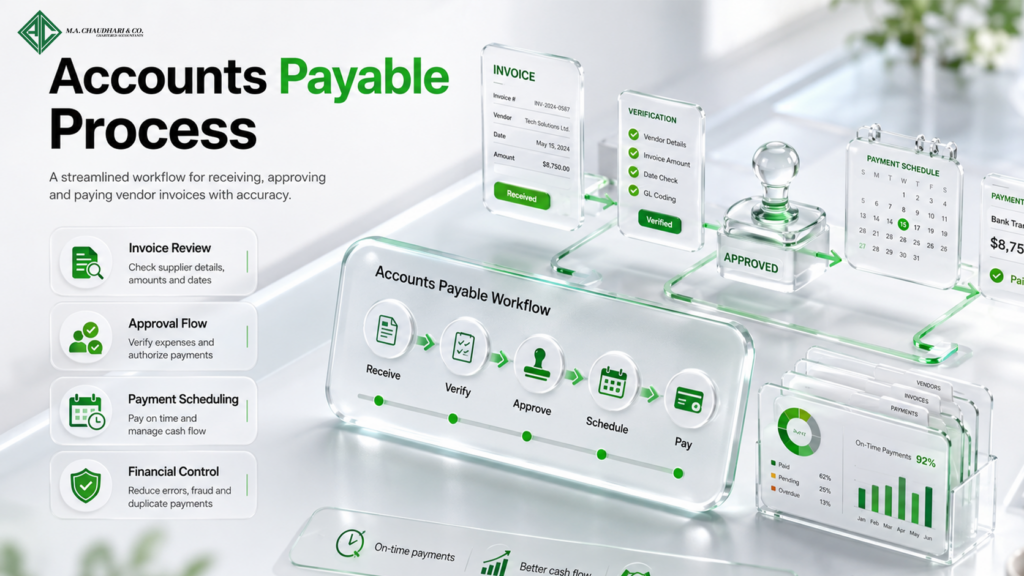
Accounts Payable Process
The accounts payable process is a structured financial workflow that businesses use to receive, review, approve, and pay invoices from suppliers or vendors. It begins when a company purchases goods or services on credit and ends when the payment is successfully made and recorded in the accounting system. This process ensures that every invoice is verified for accuracy before payment, helping businesses maintain strong financial control and healthy supplier relationships.
An efficient accounts payable process is essential for organizations of all sizes because it reduces payment errors, prevents fraud, improves cash flow management, and keeps financial records accurate. By following a standardized workflow, businesses can ensure that only valid invoices are paid, duplicate payments are avoided, and vendors receive their payments on time.
Introduction to the Accounts Payable Process
The accounts payable process manages business payments to suppliers and vendors. It helps companies track invoices, approve expenses, and complete payments accurately. Moreover, a strong accounts payable process improves financial control and reduces payment errors.
Businesses use this process to maintain healthy vendor relationships. Additionally, it supports better cash flow management and prevents unnecessary delays. Therefore, companies should create a clear and organized payment workflow.
What Is the Accounts Payable Process?
The accounts payable process is a series of steps for managing company debts. It begins when a business receives an invoice from a supplier. Then, employees review, approve, and record the invoice details.
Afterward, the company schedules payment based on agreed terms. Finally, the finance team completes the transaction and updates accounting records. As a result, businesses maintain accurate financial information.
Furthermore, this process helps companies avoid duplicate payments. It also ensures compliance with internal policies and financial regulations.
Key Steps in the Accounts Payable Process
1. Receiving and Reviewing Invoices
The first step involves collecting supplier invoices. Companies receive invoices through email, software platforms, or physical documents. Next, the accounts payable team checks invoice information carefully.
They verify supplier details, payment amounts, and invoice dates. Additionally, they confirm that products or services match purchase agreements. This step prevents incorrect payments.
2. Invoice Approval and Verification
After reviewing invoices, businesses send them for approval. Managers check whether expenses meet company requirements. Meanwhile, the finance team ensures proper authorization.
However, unclear approval processes can create delays. Therefore, companies should establish clear approval rules. Consequently, employees can process invoices faster and more efficiently.
3. Recording Invoice Information
Once approved, employees record invoice details in accounting systems. They enter supplier names, amounts, dates, and payment terms. Moreover, accurate records help businesses monitor expenses.
Modern accounting software can automate this step. Therefore, companies can reduce manual work and improve data accuracy.
4. Payment Scheduling
The next step involves planning payment dates. Businesses consider supplier agreements and available cash flow. Furthermore, they avoid late fees by paying invoices on time.
A proper payment schedule also improves vendor trust. Additionally, it allows companies to manage their financial resources effectively.
5. Completing Payments
After scheduling, the company processes payments through approved methods. These methods may include bank transfers, checks, or online payment systems.
Finally, employees confirm payment completion. They also update financial records for future reference. Thus, businesses maintain complete payment histories.
Benefits of an Efficient Accounts Payable Process
An effective accounts payable process provides several advantages. First, it improves financial accuracy by reducing mistakes. Second, it strengthens relationships with suppliers through timely payments.
Moreover, automation increases productivity. Employees spend less time handling repetitive tasks. Instead, they focus on important financial activities.
Additionally, businesses gain better visibility into spending patterns. They can analyze expenses and make smarter decisions. Therefore, an optimized process supports long-term growth.
Common Challenges in Accounts Payable Management
Many companies face challenges during payment processing. For example, manual invoice handling can cause delays. Also, missing documents can create approval problems.
Furthermore, poor communication between departments affects efficiency. However, businesses can solve these issues with better systems.
Digital tools help organize invoices and automate approvals. Consequently, companies reduce errors and improve workflow speed.
How Technology Improves the Accounts Payable Process
Technology has transformed modern accounts payable management. Automated systems can capture invoice data quickly. They can also send reminders and track approval progress.
Moreover, cloud-based platforms allow teams to access financial information easily. Therefore, businesses improve collaboration between departments.
Artificial intelligence and automation tools also provide valuable insights. They identify duplicate invoices and unusual payment activities. As a result, companies improve security and financial control.
Best Practices for Managing Accounts Payable
Companies should follow several best practices for better results. First, they should create standardized payment procedures. This approach ensures consistency across departments.
Next, businesses should train employees regularly. Proper training reduces mistakes and improves productivity. Additionally, companies should review their payment workflows frequently.
Furthermore, organizations should use reliable accounting software. Digital solutions increase speed, accuracy, and transparency. Therefore, businesses can achieve better financial performance.
Conclusion
The accounts payable process plays an essential role in business operations. It helps companies manage invoices, control expenses, and maintain supplier relationships.
Moreover, an efficient process improves cash flow and reduces financial risks. By using automation, clear procedures, and regular reviews, businesses can improve payment management.
Ultimately, a well-designed accounts payable process creates a stronger financial foundation. It supports growth, efficiency, and better decision-making.
Frequently Asked Questions (FAQ)
What is the accounts payable process?
The accounts payable process is a workflow that businesses use to manage supplier invoices, approve payments, record transactions, and complete payments accurately.
What are the main steps in the accounts payable process?
The main steps include receiving invoices, verifying information, approving payments, recording transactions, scheduling payments, and completing the payment process.
Why is the accounts payable process important for businesses?
The accounts payable process helps businesses control expenses, avoid payment errors, maintain supplier relationships, and improve cash flow management.
How can automation improve the accounts payable process?
Automation reduces manual tasks, speeds up invoice approvals, detects duplicate invoices, and improves payment accuracy.
What are common challenges in accounts payable management?
Common challenges include invoice errors, delayed approvals, missing documents, duplicate payments, and inefficient manual processes.