
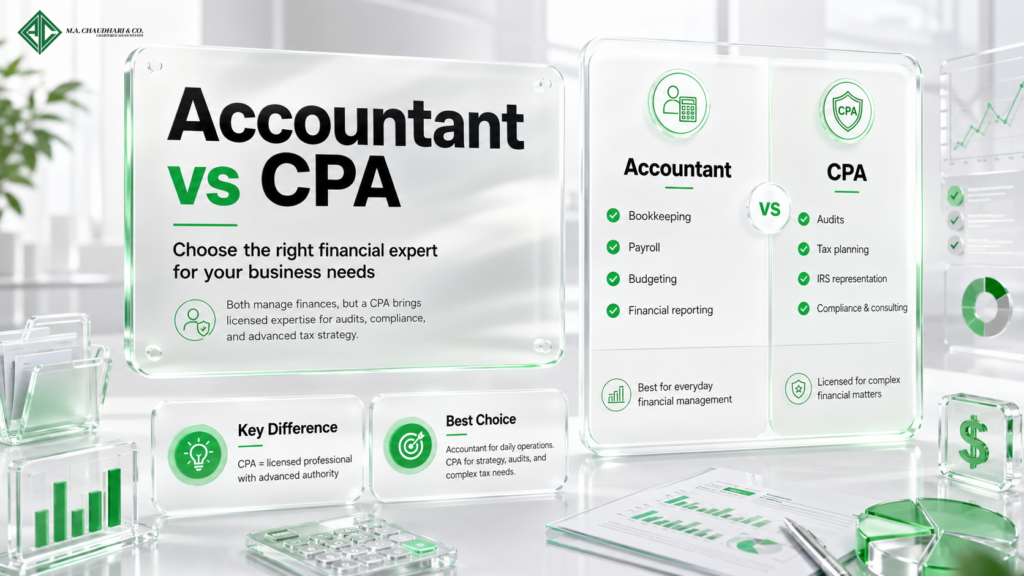
Accountant vs CPA
Choosing between an accountant and a Certified Public Accountant (CPA) depends on your financial needs. Although both professionals handle accounting tasks, their qualifications and responsibilities differ. Understanding the difference helps businesses and individuals make informed decisions. Moreover, knowing each role can guide aspiring finance professionals toward the right career path.
What Is the Difference Between an Accountant and a CPA?
An accountant manages financial records, prepares reports, and helps businesses maintain accurate books. A CPA, however, is a licensed accounting professional who has passed a rigorous examination and met state licensing requirements.
Both professionals understand accounting principles. However, a CPA has additional authority to perform specialized services, including audits and certain regulatory filings.
Who Is an Accountant?
An accountant records financial transactions and prepares financial statements. Additionally, accountants help businesses manage budgets, payroll, taxes, and bookkeeping.
Common responsibilities include:
- Recording financial data
- Preparing balance sheets
- Managing payroll
- Creating financial reports
- Monitoring expenses
- Assisting with budgeting
- Supporting tax preparation
Many accountants hold accounting degrees. However, licensing is not always required.
Who Is a CPA?
A Certified Public Accountant is a licensed accounting professional. CPAs meet strict education, examination, and experience requirements before earning their license.
A CPA can perform all standard accounting tasks. Furthermore, they provide advanced financial services that many accountants cannot legally offer.
Typical CPA services include:
- Conducting financial audits
- Representing clients before tax authorities
- Preparing complex tax returns
- Offering financial consulting
- Performing compliance reviews
- Providing assurance services
Education Requirements
Accountant Education
Most accountants earn a bachelor’s degree in accounting, finance, or a related field. Some entry-level positions also accept associate degrees combined with relevant experience.
CPA Education
CPAs generally complete a bachelor’s degree and additional college credits required by their licensing board. They must also pass the Uniform CPA Examination and meet professional experience requirements.
Therefore, becoming a CPA requires more education and training than becoming a general accountant.
Licensing and Certification
One of the biggest differences between an accountant and a CPA is licensing.
An accountant may work without a professional license in many roles. In contrast, a CPA must maintain an active license issued by the appropriate state board.
Additionally, CPAs complete continuing professional education to keep their licenses current.
Job Responsibilities
Although both professionals work with financial information, their responsibilities often differ.
Accountant Responsibilities
- Bookkeeping
- Payroll processing
- Budget planning
- Financial reporting
- Expense tracking
- Tax preparation support
CPA Responsibilities
- Financial audits
- Tax planning
- IRS representation
- Business consulting
- Risk assessment
- Regulatory compliance
As a result, CPAs often handle more complex financial matters.
Salary Comparison
Both careers offer competitive salaries. However, CPAs generally earn higher incomes because of their advanced qualifications and licensing.
Salary depends on several factors, including:
- Experience
- Industry
- Location
- Employer
- Professional certifications
Moreover, experienced CPAs often qualify for senior leadership positions.
Career Opportunities
Career Options for Accountants
Accountants work in many industries, including:
- Corporate accounting
- Small businesses
- Government agencies
- Nonprofit organizations
- Financial services
Career Options for CPAs
CPAs enjoy broader career opportunities, such as:
- Public accounting firms
- Audit departments
- Tax advisory firms
- Financial consulting
- Corporate finance
- Executive leadership roles
Therefore, CPA certification can open more advanced career paths.
When Should You Hire an Accountant?
An accountant is a great choice for everyday financial management.
Consider hiring an accountant if you need:
- Bookkeeping services
- Payroll management
- Budget preparation
- Financial reporting
- Basic tax assistance
These services help businesses maintain organized financial records throughout the year.
When Should You Hire a CPA?
A CPA is the better option for complex financial situations.
Choose a CPA when you need:
- Financial statement audits
- Tax planning strategies
- IRS representation
- Business restructuring advice
- Regulatory compliance support
- High-level financial consulting
Consequently, businesses with growing financial responsibilities often benefit from CPA expertise.
Accountant vs CPA: Which Is Better?
Neither profession is better in every situation. Instead, the right choice depends on your needs.
If you need routine bookkeeping and financial management, an accountant is usually sufficient. However, if you require audits, advanced tax planning, or regulatory expertise, a CPA offers greater value.
Understanding these differences allows businesses and individuals to select the right financial professional.
Conclusion
Understanding the differences between an accountant and a CPA helps you choose the right financial professional. While accountants manage daily financial operations, CPAs offer licensed expertise for audits, compliance, and advanced tax services. Whether you need routine bookkeeping or strategic financial guidance, selecting the right expert supports better financial decisions and long-term success.
Frequently Asked Questions
Is a CPA better than an accountant?
A CPA has additional licensing and qualifications. However, an accountant may be the better choice for routine bookkeeping and day-to-day financial tasks.
Can an accountant become a CPA?
Yes. An accountant can become a CPA by meeting education requirements, gaining professional experience, passing the CPA exam, and obtaining a license.
Do all accountants have CPA licenses?
No. Many accountants work successfully without becoming CPAs. CPA licensing is an optional professional credential that requires additional qualifications.
Who earns more, an accountant or a CPA?
CPAs generally earn higher salaries because they hold professional licenses and can provide specialized accounting services.
Should a small business hire an accountant or a CPA?
Most small businesses benefit from an accountant for everyday financial management. However, hiring a CPA is recommended for audits, tax planning, and complex financial matters.