
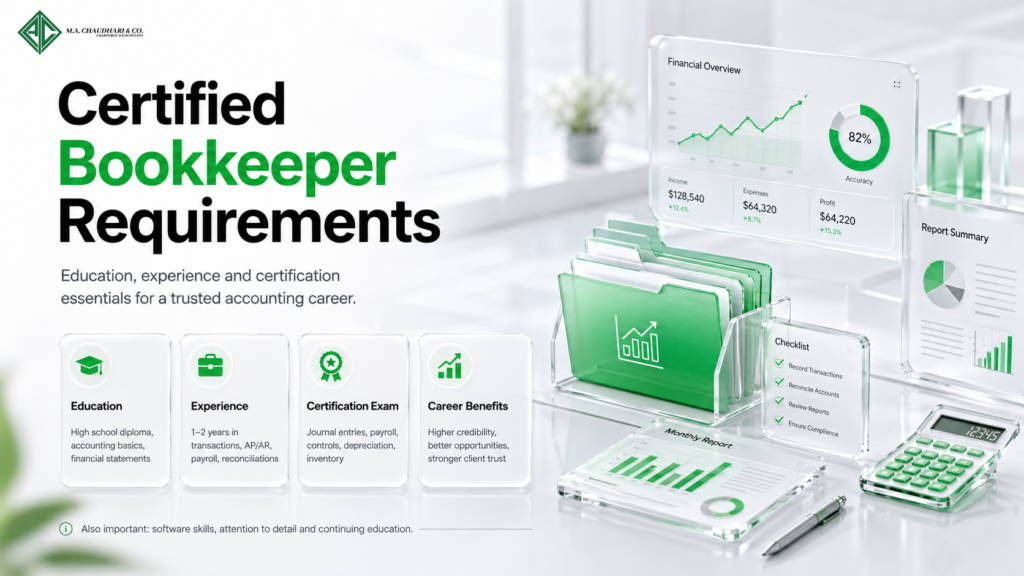
Certified Bookkeeper Requirements
Becoming a certified bookkeeper strengthens your financial knowledge and improves career opportunities. Certified bookkeeper requirements vary by organization. However, most programs follow similar standards. Meeting these requirements demonstrates accuracy, professionalism, and commitment. As a result, employers and clients trust certified bookkeepers more than non-certified professionals.
What Are Certified Bookkeeper Requirements?
Certified bookkeeper requirements include education, work experience, and passing a certification exam. Additionally, candidates must understand bookkeeping principles and financial reporting. Some certification providers also require continuing education to maintain credentials.
Although requirements differ, most programs focus on practical accounting knowledge. Therefore, candidates should prepare carefully before applying.
Educational Requirements for Certified Bookkeepers
A college degree is not always mandatory. However, a strong educational foundation helps candidates succeed.
Most certification programs expect applicants to have:
- A high school diploma or equivalent
- Basic accounting knowledge
- Understanding of bookkeeping software
- Familiarity with financial statements
- Knowledge of payroll and tax basics
Furthermore, completing bookkeeping courses improves exam readiness. Many employers also value formal accounting education.
Work Experience Requirements
Experience remains one of the most important certified bookkeeper requirements. Many organizations require practical bookkeeping work before certification.
Typical experience includes:
- Recording financial transactions
- Managing accounts payable
- Handling accounts receivable
- Reconciling bank statements
- Preparing financial reports
- Processing payroll
Generally, one to two years of bookkeeping experience satisfies most certification standards. However, candidates should verify specific requirements before applying.
Certification Examination Requirements
Passing a professional examination proves bookkeeping competency. Therefore, candidates should study every exam topic thoroughly.
Most certification exams cover:
- Accounting fundamentals
- Adjusting journal entries
- Payroll procedures
- Internal controls
- Financial statement preparation
- Error correction
- Depreciation methods
- Inventory accounting
In addition, practice exams help candidates identify weak areas. Consistent preparation often improves overall performance.
Essential Skills Every Certified Bookkeeper Needs
Meeting certified bookkeeper requirements involves more than education and experience. Strong professional skills also matter.
Successful bookkeepers develop:
- Excellent attention to detail
- Strong mathematical abilities
- Organizational skills
- Time management
- Communication skills
- Problem-solving abilities
- Data accuracy
- Confidentiality practices
Moreover, these skills increase workplace efficiency and reduce costly financial errors.
Software Knowledge Requirements
Modern bookkeeping relies heavily on technology. Therefore, software proficiency has become an essential requirement.
Certified bookkeepers should understand:
- QuickBooks
- Xero
- Sage
- FreshBooks
- Microsoft Excel
- Cloud accounting platforms
Additionally, employers prefer candidates who adapt quickly to new financial technologies.
Continuing Education Requirements
Certification does not end after passing the exam. Instead, many organizations require continuing education to maintain active credentials.
Continuing education may include:
- Professional development courses
- Accounting seminars
- Tax law updates
- Ethics training
- Industry conferences
Consequently, certified bookkeepers stay current with changing accounting standards and regulations.
Benefits of Meeting Certified Bookkeeper Requirements
Completing certified bookkeeper requirements offers several professional advantages.
Key benefits include:
- Greater employment opportunities
- Higher earning potential
- Increased client confidence
- Stronger professional credibility
- Better promotion prospects
- Expanded career flexibility
Furthermore, certification demonstrates dedication to maintaining high bookkeeping standards.
How to Prepare for Certification
Preparation plays a major role in certification success. Therefore, candidates should create a structured study plan.
Helpful preparation strategies include:
- Review accounting fundamentals daily.
- Practice bookkeeping exercises regularly.
- Complete sample examinations.
- Improve spreadsheet skills.
- Learn accounting software thoroughly.
- Join professional bookkeeping communities.
- Stay consistent with study schedules.
Additionally, regular practice builds confidence before exam day.
Common Mistakes to Avoid
Many candidates struggle because they overlook important details. Fortunately, avoiding common mistakes improves certification success.
Avoid these errors:
- Ignoring exam objectives
- Skipping practical exercises
- Relying only on memorization
- Neglecting software training
- Poor time management
- Failing to review financial statements
Instead, focus on both theoretical knowledge and real-world bookkeeping experience.
Career Opportunities After Certification
Meeting certified bookkeeper requirements opens many career paths. Certified professionals work across multiple industries.
Popular career options include:
- Certified Bookkeeper
- Accounting Assistant
- Payroll Specialist
- Accounts Payable Clerk
- Accounts Receivable Specialist
- Finance Administrator
- Small Business Bookkeeper
- Freelance Bookkeeping Consultant
Moreover, experienced professionals may eventually advance into senior accounting roles.
Conclusion
Understanding certified bookkeeper requirements helps aspiring professionals prepare for long-term success. Education, practical experience, and certification exams form the foundation of professional bookkeeping. Additionally, software knowledge and continuing education keep skills current. By meeting every requirement, bookkeepers strengthen their credibility, improve job prospects, and build rewarding careers in accounting.
Frequently Asked Questions
What qualifications do I need to become a certified bookkeeper?
Most certification programs require a high school diploma, bookkeeping knowledge, practical work experience, and passing a certification exam.
Do I need a college degree to become a certified bookkeeper?
No. Most certification providers do not require a college degree. However, accounting courses can improve your knowledge and job opportunities.
How long does it take to become a certified bookkeeper?
The timeline varies. Most candidates complete the process within one to two years, depending on their experience and study schedule.
Which bookkeeping software should I learn?
QuickBooks, Xero, Sage, FreshBooks, and Microsoft Excel are among the most commonly used bookkeeping tools.
Is certification worth it for bookkeepers?
Yes. Certification improves credibility, increases job opportunities, and may lead to higher salaries and better career advancement.