
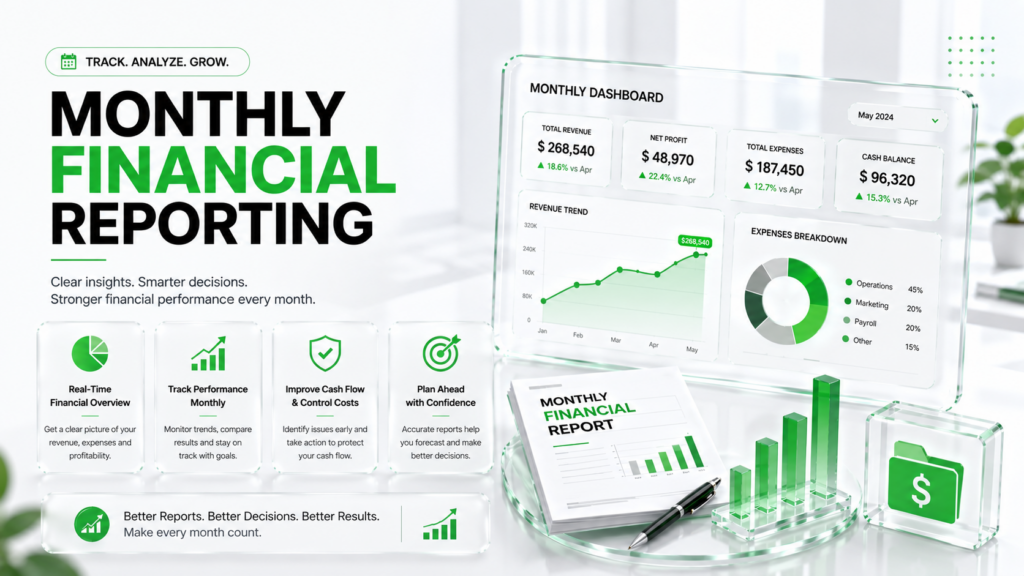
Monthly Financial Reporting
Monthly financial reporting is like driving a car without looking at the dashboard. You might keep moving for a while, but eventually you’ll miss warning signs that could lead to expensive mistakes. Whether you own a startup, manage a growing company, or oversee the finances of a large organization, monthly financial reports provide a clear snapshot of your company’s financial health. They reveal where your money is coming from, where it’s going, and whether your business is moving toward its goals.
Modern finance professionals increasingly view monthly reporting as more than a compliance exercise. It has become a strategic management tool that supports faster decision-making, improves forecasting, and helps leaders respond quickly to changing market conditions. Recent industry guidance also emphasizes designing reports around business decisions instead of simply presenting raw financial data. Finance teams that focus on actionable insights rather than lengthy spreadsheets consistently deliver greater value to executives.
One recent survey of 2,500 investment professionals found that 63% believe the benefits of regular financial reporting outweigh its costs, while investors overwhelmingly support timely reporting because it improves transparency and decision-making. These findings reinforce why businesses of every size benefit from maintaining a disciplined monthly reporting process.
What Is Monthly Financial Reporting?
Monthly financial reporting is the process of preparing and reviewing financial statements at the end of every month. These reports summarize the company’s financial activities over the previous month and help management evaluate operational performance. Rather than waiting until the end of a quarter or fiscal year, businesses receive timely financial information that allows them to identify trends, solve problems early, and adjust strategies before small issues become major financial challenges.
Unlike annual reports, which primarily serve investors and regulatory requirements, monthly reports are designed for internal decision-makers. Business owners, finance managers, department heads, and executives rely on these reports to monitor profitability, expenses, cash flow, sales performance, and operational efficiency. Modern finance experts recommend that reports answer business questions and support decisions instead of overwhelming readers with unnecessary numbers.
Monthly reporting also establishes consistency throughout the year. Organizations that maintain disciplined month-end reporting often experience smoother year-end audits because reconciliations, adjustments, and financial reviews happen continuously instead of accumulating until year-end. Government financial reporting guidance similarly recommends aligning monthly reporting with year-end processes to improve accuracy and reduce reporting delays.
Definition and Purpose
At its core, monthly financial reporting is a structured process that converts raw financial transactions into meaningful information. Every sale, purchase, payroll transaction, tax payment, loan installment, and operating expense recorded throughout the month eventually becomes part of a financial report. The purpose is not simply to organize accounting records but to provide management with reliable information for making informed business decisions. Without accurate monthly reports, leaders are forced to rely on assumptions instead of facts, increasing the risk of poor financial planning and costly mistakes. A company may appear profitable based on sales alone, but monthly financial reporting often reveals hidden issues such as rising operating expenses, declining gross margins, increasing customer payment delays, or excessive inventory costs.
Why Businesses Need Monthly Reports
Many small business owners mistakenly believe financial reporting is only necessary for tax filing or annual audits. In reality, successful companies understand that monthly financial reporting serves as a management tool rather than merely an accounting requirement. Every month brings changes in sales trends, operating costs, customer behavior, supplier pricing, and cash flow. Waiting until the end of the year to analyze these changes often means discovering problems long after they could have been corrected. Monthly reports provide timely visibility into business performance, helping leaders identify opportunities and risks while there is still enough time to respond effectively.
Cash flow management is one of the strongest reasons businesses prepare monthly reports. A profitable business can still face financial distress if customers delay payments or operating expenses increase unexpectedly. Monthly reporting helps finance teams monitor accounts receivable, accounts payable, available cash, upcoming obligations, and working capital. If cash balances begin declining over several months, management can reduce discretionary spending, accelerate customer collections, negotiate supplier payment terms, or secure financing before cash shortages disrupt operations. This proactive approach significantly reduces financial uncertainty and improves overall business resilience.
Key Components of Monthly Financial Reporting
Monthly financial reporting is not a single document but a collection of interconnected reports that provide a complete picture of an organization’s financial health. Each report focuses on a different aspect of business performance, and together they help management evaluate profitability, liquidity, operational efficiency, and financial stability. Looking at only one report can lead to misleading conclusions. For example, a company may report strong profits on its income statement while simultaneously experiencing serious cash flow problems because customers have not yet paid their invoices. Similarly, healthy cash reserves do not necessarily indicate long-term financial strength if liabilities continue growing faster than assets.
The primary goal of combining multiple financial reports is to provide balanced insights rather than isolated numbers. Finance professionals analyze relationships between revenue, expenses, assets, liabilities, equity, and cash movement to understand what is truly happening inside the business. Modern accounting software integrates these reports into interactive dashboards, allowing decision-makers to compare monthly performance with budgets, previous periods, and annual targets. This integrated approach transforms financial reporting from a historical record into a forward-looking management system capable of supporting better forecasting and strategic planning.
Income Statement
The Income Statement, often referred to as the Profit and Loss (P&L) Statement, is one of the most important documents included in monthly financial reporting. Its primary purpose is to show whether the business made a profit or incurred a loss during a specific month. Unlike the Balance Sheet, which presents the company’s financial position at a single point in time, the Income Statement focuses on financial performance over a reporting period. It summarizes revenue earned, expenses incurred, and the resulting net profit or net loss. Business owners, investors, and managers rely heavily on this report because it provides a straightforward answer to one of the most important questions in business: Is the company making money?
A typical Income Statement begins with total revenue generated from sales of goods or services. From this figure, the Cost of Goods Sold (COGS) is deducted to calculate Gross Profit. Gross Profit reveals how efficiently the company produces or delivers its products before considering operating expenses. Next, operating expenses such as employee salaries, office rent, utilities, insurance, software subscriptions, advertising costs, depreciation, and administrative expenses are deducted. This calculation produces Operating Income, which reflects the profitability of the company’s core business activities. Finally, non-operating items like interest income, loan interest expenses, taxes, and extraordinary gains or losses are included to determine the Net Profit, often referred to as the company’s bottom line.
Common Sections of an Income Statement
| Section | Purpose |
|---|---|
| Revenue | Total income generated from sales and services |
| Cost of Goods Sold (COGS) | Direct costs associated with producing goods or services |
| Gross Profit | Revenue minus COGS |
| Operating Expenses | Administrative, selling, marketing, salaries, rent, and utilities |
| Operating Income | Profit from core business operations |
| Other Income & Expenses | Interest, investments, taxes, and one-time gains or losses |
| Net Profit | Final earnings after all expenses and taxes |
Balance Sheet
The Balance Sheet is another essential component of monthly financial reporting because it provides a snapshot of a company’s financial position at a specific point in time. While the Income Statement answers the question, “How much profit did we make this month?” the Balance Sheet answers, “What does the business own, what does it owe, and how much value belongs to the owners right now?” This report is built around the fundamental accounting equation:
Assets = Liabilities + Owner’s Equity
This equation forms the foundation of modern accounting and ensures that every financial transaction remains balanced. If a business purchases equipment using a bank loan, both assets and liabilities increase. If it earns profit and retains those earnings, owner’s equity increases. Every transaction ultimately affects at least two accounts, maintaining balance throughout the financial reporting process.
Cash Flow Statement
While the Income Statement measures profitability and the Balance Sheet presents the company’s financial position, the Cash Flow Statement focuses on one of the most critical aspects of monthly financial reporting the movement of cash. Many profitable businesses have failed because they ran out of cash, not because they lacked sales or customers. Profit and cash are not the same thing. A company may record revenue when an invoice is issued, but if the customer pays 60 days later, the business still needs enough cash to cover salaries, rent, utilities, supplier payments, and taxes during that period. This is why finance professionals often say, “Cash is the lifeblood of a business.” The Cash Flow Statement helps management understand exactly how cash enters and leaves the organization, ensuring there is enough liquidity to support daily operations.
The Cash Flow Statement is divided into three major sections: Operating Activities, Investing Activities, and Financing Activities. Cash generated from Operating Activities includes customer payments, supplier payments, employee salaries, taxes, and other routine business transactions. This section reveals whether the company’s core business operations are producing enough cash to sustain growth without relying heavily on loans or investments. A business that consistently generates positive operating cash flow is generally considered financially healthy because its primary operations fund ongoing expenses and expansion.
Types of Cash Flows
| Cash Flow Category | Examples |
|---|---|
| Operating Activities | Customer receipts, salaries, rent, utilities, taxes, supplier payments |
| Investing Activities | Equipment purchases, property acquisition, sale of fixed assets |
| Financing Activities | Bank loans, loan repayments, dividends, owner investments |
Financial KPIs and Dashboards
Traditional financial statements provide valuable information, but executives often need faster insights than dozens of pages of financial reports can provide. This is where Financial Key Performance Indicators (KPIs) and management dashboards become indispensable parts of monthly financial reporting. KPIs transform raw accounting data into measurable performance indicators that allow decision-makers to evaluate business health at a glance. Rather than reading every line item in an Income Statement or Balance Sheet, executives can review carefully selected metrics that highlight profitability, efficiency, liquidity, and growth trends. Dashboards combine these metrics into visual reports using charts, graphs, and trend indicators, making financial analysis easier for both finance and non-finance managers.
One of the biggest advantages of financial dashboards is their ability to simplify complex financial information. Imagine trying to understand a company’s financial health by reading hundreds of accounting transactions every month. The process would be overwhelming and time-consuming. Dashboards act like the control panel of an airplane, displaying only the most important indicators that require immediate attention. If a KPI moves outside its acceptable range, management can investigate the underlying cause before the issue becomes significant. This allows organizations to respond quickly instead of waiting until quarterly or annual reporting cycles.
Benefits of Monthly Financial Reporting
Monthly financial reporting is much more than a routine accounting task. It is a powerful management practice that provides business leaders with timely, accurate, and actionable financial information. Companies that prepare reports only once a year often discover financial problems long after they have affected profitability, cash flow, or customer satisfaction. In contrast, organizations that analyze their finances every month gain continuous visibility into business performance, allowing them to make informed decisions before minor issues become major setbacks. Whether the business is a small startup, a rapidly growing company, or a multinational corporation, regular financial reporting creates a culture of accountability, transparency, and strategic planning.
The value of monthly reporting extends beyond the finance department. Sales managers can evaluate whether revenue targets are being achieved, operations managers can monitor production costs, marketing teams can measure campaign profitability, and executives can assess overall business performance using reliable financial data. Rather than making decisions based on assumptions or intuition, every department benefits from objective information that reflects actual business results. This improves collaboration because departments share a common understanding of financial priorities and organizational goals.
Better Decision-Making
Every successful business decision begins with reliable information, and this is precisely where monthly financial reporting delivers its greatest value. Decisions involving hiring employees, launching new products, expanding into new markets, purchasing equipment, increasing marketing budgets, or obtaining financing all carry financial consequences. Without current financial reports, management may rely on outdated information or personal assumptions, increasing the likelihood of costly mistakes. Monthly reporting provides an accurate picture of the organization’s financial condition, enabling leaders to evaluate opportunities and risks with greater confidence.
Decision-making improves because monthly reports combine profitability, liquidity, operational performance, and financial stability into a single reporting package. Suppose management notices that sales are increasing while operating expenses are rising even faster. Rather than celebrating revenue growth alone, executives can investigate expense categories to determine whether additional spending is generating acceptable returns. Similarly, if customer demand increases unexpectedly, financial reports can help determine whether the business has sufficient cash, inventory, and working capital to support expansion without creating unnecessary financial strain.
Improved Cash Flow Management
Cash flow is often described as the engine that keeps a business running. Even companies with impressive sales and healthy profits can experience financial distress if cash is unavailable when bills become due. This is why monthly financial reporting places significant emphasis on cash flow management. Regular reporting enables businesses to monitor incoming and outgoing cash, ensuring sufficient liquidity to meet payroll, supplier obligations, tax payments, loan installments, and operating expenses without interruption. Instead of discovering cash shortages unexpectedly, management gains advance warning through detailed monthly analysis.
One of the primary advantages of monthly cash flow monitoring is early problem detection. If customers begin delaying invoice payments, the impact becomes visible long before the company experiences serious liquidity issues. Likewise, if supplier costs increase or operating expenses rise unexpectedly, monthly reports allow management to investigate the reasons immediately. Rather than waiting until financial pressure becomes overwhelming, businesses can accelerate collections, negotiate improved payment terms with suppliers, postpone non-essential expenditures, or arrange short-term financing before cash reserves become critically low.
Budget Monitoring and Forecasting
Monthly financial reporting plays a vital role in budget monitoring and forecasting by helping businesses compare actual financial results with planned budgets. Regular comparisons allow management to identify overspending, revenue shortfalls, or unexpected costs early, making it easier to take corrective action before small issues become major financial problems.
Forecasting also becomes more accurate because it is based on current financial data rather than assumptions. By analyzing monthly trends in sales, expenses, and cash flow, businesses can estimate future performance, plan investments, manage resources efficiently, and prepare for seasonal changes. Accurate forecasts improve decision-making, reduce financial risks, and help organizations achieve their long-term goals while maintaining financial stability.
How to Prepare Monthly Financial Reports
Preparing monthly financial reporting requires accuracy and consistency. Start by recording all financial transactions for the month, including sales, expenses, payroll, and bank activities. Next, reconcile bank accounts, review invoices, verify accounts receivable and payable, and make any necessary adjusting entries such as depreciation or accruals.
Once the data is verified, generate the core financial statements: the Income Statement, Balance Sheet, and Cash Flow Statement. Compare the results with previous months and the budget to identify significant changes. Finally, review the reports with management, discuss key findings, and use the insights to make informed business decisions for the following month.
Month-End Closing Process
The month-end closing process ensures that all financial information is complete and accurate before reports are prepared. It includes recording outstanding transactions, reconciling bank accounts, reviewing inventory, verifying payroll, and posting adjusting journal entries. Completing these tasks consistently each month improves reporting accuracy and simplifies year-end financial reporting and audits.
Data Collection and Reconciliation
Accurate financial reports depend on reliable data. Businesses should collect information from accounting software, bank statements, invoices, payroll records, and expense receipts. Reconciliation ensures that accounting records match external documents, helping identify errors, duplicate entries, or missing transactions before reports are finalized.
Report Review and Analysis
Preparing reports is only the first step; analyzing them creates real value. Management should review revenue, expenses, profit margins, cash flow, and key financial ratios to identify trends and unusual changes. Comparing monthly performance against budgets and previous periods helps uncover opportunities for cost savings, improved efficiency, and stronger profitability.
Best Practices for Effective Monthly Financial Reporting
Consistent reporting practices improve the quality and usefulness of financial information. Businesses should establish a standardized reporting schedule, use reliable accounting software, automate repetitive tasks where possible, and ensure reports are reviewed promptly after month-end. Maintaining accurate records throughout the month also reduces the workload during the closing process.
Automation and Accounting Software
Modern accounting software simplifies monthly financial reporting by automatically recording transactions, generating financial statements, reconciling bank accounts, and creating management dashboards. Automation reduces manual errors, saves time, and provides real-time financial insights, allowing finance teams to focus on analysis rather than data entry.
Common Mistakes to Avoid
Some common mistakes can reduce the accuracy and usefulness of monthly reports:
- Delaying the month-end closing process.
- Failing to reconcile bank accounts.
- Recording incomplete or inaccurate transactions.
- Ignoring cash flow trends.
- Comparing reports without considering seasonal factors.
- Focusing only on profit while overlooking liquidity.
- Not reviewing reports with management.
Avoiding these mistakes helps businesses make better financial decisions and maintain reliable financial records.
Conclusion
Monthly financial reporting is an essential management tool that helps businesses understand their financial performance, monitor cash flow, control expenses, and make informed decisions. By preparing accurate Income Statements, Balance Sheets, Cash Flow Statements, and financial dashboards every month, organizations gain valuable insights into their operations and can respond quickly to changing business conditions.
Regular reporting also supports budgeting, forecasting, risk management, and long-term strategic planning. Whether you’re managing a small business or a large enterprise, consistent monthly financial reporting provides the financial visibility needed to improve profitability, maintain healthy cash flow, and achieve sustainable business growth.
Frequently Asked Questions (FAQs)
1. What is monthly financial reporting?
Monthly financial reporting is the process of preparing financial statements every month to evaluate a company’s financial performance, cash flow, and overall financial position.
2. Why is monthly financial reporting important?
It helps businesses make informed decisions, monitor profitability, manage cash flow, identify financial issues early, and improve budgeting and forecasting.
3. What reports are included in monthly financial reporting?
The main reports include the Income Statement, Balance Sheet, Cash Flow Statement, and financial KPI dashboards.
4. Who uses monthly financial reports?
Business owners, executives, finance managers, investors, lenders, and department managers use these reports to evaluate financial performance and support decision-making.
5. How can businesses improve their monthly financial reporting?
Businesses can improve reporting by maintaining accurate records, automating accounting processes, reconciling accounts regularly, following a consistent month-end closing process, and reviewing reports promptly with management.
.