
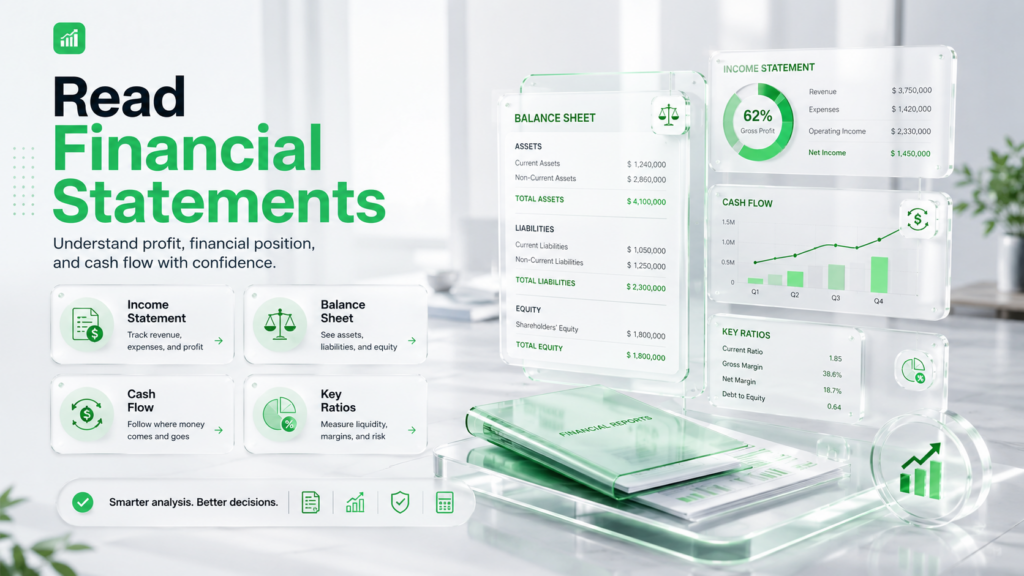
Read Financial Statements
Read financial statements with confidence, and you’ll gain one of the most valuable skills in business and finance. Whether you’re an entrepreneur, investor, accountant, student, or manager, the ability to read financial statements helps you understand a company’s financial health without relying on someone else’s opinion. These reports reveal how much money a business earns, how it spends that money, what it owns, what it owes, and whether it has enough cash to continue operating successfully. Once you understand how to interpret these reports, you can make smarter financial decisions, identify potential risks, and recognize growth opportunities before others do.
Many beginners believe financial statements are difficult because they contain technical accounting terms and large amounts of numerical data. In reality, every financial statement tells part of a story. The income statement explains profitability, the balance sheet shows financial position, and the cash flow statement reveals how money moves through the business. When these reports are analyzed together, they provide a complete picture of business performance.
This guide explains everything you need to know to read financial statements like a professional. You’ll learn how each financial report works, which numbers matter most, how to evaluate business performance, the financial ratios experts rely on, and the common mistakes beginners should avoid.
Why You Should Read Financial Statements
The ability to read financial statements is one of the most valuable business skills you can develop. Financial statements are official reports that summarize a company’s financial activities during a specific period. Rather than reviewing thousands of daily transactions, these reports present organized information that helps business owners, investors, lenders, and managers understand how a company is performing. Every important financial decision, from approving a business loan to purchasing company shares, depends on accurate financial reporting.
Financial statements also improve transparency. Investors use them to determine whether a company deserves their investment. Banks analyze them before approving loans, while business owners rely on them to measure profitability and monitor growth. Government agencies may also require financial statements for taxation and regulatory compliance. Because these reports influence so many decisions, accuracy is essential.
Learning to read financial statements enables you to identify profitable businesses, recognize financial warning signs, compare companies within the same industry, and evaluate long-term growth potential. Instead of relying solely on headlines or opinions, you can make decisions using reliable financial information. As your understanding improves, these reports become valuable tools that support smarter business and investment choices.
Benefits of Understanding Financial Reports
When you can read financial statements, you gain access to information that many people overlook. Instead of simply knowing whether a business earned a profit, you understand how that profit was generated, whether expenses remain under control, and whether the company has sufficient cash to continue operating successfully.
Some of the biggest benefits include:
- Making informed investment decisions.
- Evaluating business performance accurately.
- Detecting financial risks early.
- Improving budgeting and financial planning.
- Understanding business profitability.
- Supporting better lending decisions.
- Comparing companies objectively.
Financial literacy is becoming increasingly important in today’s competitive economy. Whether you manage your own business or simply want to invest wisely, understanding financial statements provides a strong foundation for future success.
Read Financial Statements by Understanding Their Purpose
Before analyzing numbers, you should understand why financial statements exist. Their primary purpose is to communicate financial information clearly and consistently. Every business transaction eventually appears in one or more financial statements, allowing users to evaluate financial performance without examining individual invoices or receipts.
Companies prepare financial statements according to established accounting standards, ensuring consistency from one reporting period to another. This consistency allows investors and analysts to compare results across multiple years and even between competing businesses.
When you read financial statements, remember that each report answers a different question. The income statement asks whether the business earned a profit. The balance sheet asks what the company owns and owes. The cash flow statement explains where cash came from and where it was spent. Together, these reports provide a complete overview of business performance.
Another important purpose of financial statements is accountability. Shareholders expect management to use company resources responsibly, and financial statements provide measurable evidence of those efforts. Lenders also review these reports before extending credit because they reveal the company’s ability to repay debt. Understanding these objectives helps readers interpret financial information more effectively.
Who Uses Financial Statements
Financial statements serve many different audiences, each with unique goals. Understanding who uses these reports helps explain why they contain so much detailed information.
Business owners rely on financial statements to evaluate profitability, manage expenses, monitor cash flow, and plan future expansion. Investors examine them before purchasing shares because they want to identify companies capable of delivering long-term returns. Banks review financial statements to assess lending risk, while suppliers evaluate them before offering trade credit.
Government agencies also depend on financial statements to verify tax obligations and regulatory compliance. Employees may analyze financial reports to understand the stability of their employer, while potential business partners review them before entering strategic partnerships.
Because so many stakeholders depend on these reports, businesses must prepare them carefully and maintain accurate accounting records throughout the year. Learning to read financial statements allows you to interpret this information with greater confidence and make informed financial decisions regardless of your role.
Types of Financial Statements
To read financial statements effectively, you need to understand the three primary financial reports every business prepares. Each report focuses on a different aspect of financial performance, but together they present a complete picture of the organization’s financial health.
| Financial Statement | Primary Purpose | Main Information Included |
|---|---|---|
| Income Statement | Measures profitability | Revenue, expenses, net income |
| Balance Sheet | Shows financial position | Assets, liabilities, owner’s equity |
| Cash Flow Statement | Tracks cash movement | Operating, investing, financing cash flows |
Each statement supports the others. Profit shown on the income statement affects owner’s equity on the balance sheet, while cash collected and spent appears in the cash flow statement. Reviewing all three together provides far better insight than relying on a single report.
Balance Sheet
The Balance Sheet provides a snapshot of a company’s financial position at a specific point in time. While the income statement explains how much profit or loss a business generated during a period, the balance sheet shows what the business owns, what it owes, and how much belongs to the owners. If you want to read financial statements with confidence, learning to interpret the balance sheet is just as important as understanding the income statement because it reveals the company’s financial strength and stability.
The balance sheet is based on the fundamental accounting equation:
Assets = Liabilities + Owner’s Equity
This equation always remains balanced because every business transaction affects at least two accounts. Assets represent everything the company owns, including cash, inventory, equipment, buildings, and accounts receivable. Liabilities are the company’s obligations, such as supplier payments, loans, taxes payable, and other debts. Owner’s equity represents the owner’s investment plus retained earnings accumulated over time.
When you read financial statements, don’t just look at the total asset value. Instead, compare current assets with current liabilities to evaluate short-term financial health. A company with sufficient current assets can generally meet its short-term obligations more comfortably than one with limited liquidity. You should also examine long-term liabilities because excessive debt can reduce future profitability and increase financial risk. By reviewing these relationships, you gain a much clearer understanding of the company’s financial condition than by looking at profit figures alone.
Cash Flow Statement
Among the three major financial reports, the Cash Flow Statement often provides the clearest picture of a company’s financial reality. A business may report healthy profits but still struggle to pay employees or suppliers if it lacks sufficient cash. Learning to read financial statements properly means understanding that profit and cash are not always the same thing.
The cash flow statement explains where cash comes from and where it goes during an accounting period. It is divided into three sections:
| Cash Flow Activity | Purpose | Examples |
|---|---|---|
| Operating Activities | Cash generated from daily business operations | Customer receipts, supplier payments, salaries |
| Investing Activities | Cash used for investments | Buying equipment, selling assets |
| Financing Activities | Cash related to financing | Bank loans, issuing shares, paying dividends |
Positive operating cash flow usually indicates that the company’s core business is generating enough money to sustain daily operations. Negative investing cash flow may actually be a positive sign if the company is investing in new equipment or expanding its operations. Financing activities reveal whether the company depends heavily on borrowing or external investors to fund growth.
As you read financial statements, compare operating cash flow with net income. A business that consistently reports profits but generates weak operating cash flow deserves closer examination because accounting profits do not always translate into available cash.
Read Financial Statements Step by Step
Many beginners feel overwhelmed by financial reports because they don’t know where to start. Fortunately, you can read financial statements effectively by following a simple and logical process. Instead of jumping between reports randomly, review them in the same order each time. This structured approach helps you understand how the statements connect and reduces the chance of overlooking important information.
Step 1: Analyze Revenue
Revenue is the foundation of every financial analysis because it represents the income generated from selling products or services. When you read financial statements, begin by examining total revenue and comparing it with previous reporting periods. Consistent revenue growth often suggests increasing customer demand, successful marketing efforts, or business expansion.
However, revenue growth alone is not enough. Determine whether the increase results from higher sales volume, increased prices, or one-time events. Businesses with stable and diversified revenue sources generally face lower financial risk than companies that rely on a single customer or product line. Looking beyond the headline revenue figure provides a much more accurate assessment of business performance.
Step 2: Review Expenses
After reviewing revenue, the next step is evaluating expenses. Every business incurs costs such as salaries, rent, utilities, marketing, insurance, depreciation, and inventory purchases. Learning to read financial statements involves understanding how these expenses affect overall profitability.
Compare current expenses with previous years and calculate their percentage of total revenue. If operating costs continue increasing faster than sales, profit margins may begin shrinking. Pay particular attention to unusual or one-time expenses because they can temporarily reduce profits without reflecting the company’s normal operations.
Efficient businesses maintain reasonable expense growth while increasing revenue. Monitoring expense trends allows you to identify operational improvements as well as potential financial challenges before they become serious problems.
Step 3: Evaluate Assets and Liabilities
The balance sheet provides valuable information about financial stability. When you read financial statements, compare assets and liabilities rather than examining each figure independently. Strong businesses generally maintain sufficient assets to support operations while keeping debt at manageable levels.
Current assets such as cash, inventory, and accounts receivable should comfortably exceed short-term liabilities. This relationship indicates that the company can meet upcoming financial obligations without significant difficulty. Long-term assets such as buildings and machinery should also support future business growth rather than becoming underutilized investments.
Liabilities deserve equal attention. Excessive borrowing may increase interest costs and reduce financial flexibility. A company with moderate debt and growing equity often represents a lower financial risk than one heavily dependent on borrowed funds.
Step 4: Examine Cash Flow
Cash flow completes your financial analysis. Even profitable businesses can encounter financial trouble if they fail to generate enough cash from operations. As you read financial statements, carefully review operating cash flow because it reflects the company’s ability to finance its daily activities without relying heavily on external borrowing.
Compare cash flow trends over multiple reporting periods. Stable or increasing operating cash flow usually indicates healthy business operations. Large fluctuations may require additional investigation, particularly if profits remain stable while cash flow declines significantly.
Also examine investing and financing cash flows to understand management’s long-term strategy. Companies investing in expansion today may experience stronger growth in the future, while businesses relying heavily on loans should be evaluated carefully for potential financial risk.
Read Financial Statements Using Financial Ratios
Financial ratios transform raw accounting numbers into meaningful performance indicators. Once you learn to read financial statements, ratios allow you to compare companies of different sizes and identify strengths or weaknesses more quickly than reviewing individual figures alone.
Some of the most useful financial ratios include:
| Ratio | Formula | Purpose |
|---|---|---|
| Gross Profit Margin | Gross Profit ÷ Revenue | Measures production profitability |
| Net Profit Margin | Net Income ÷ Revenue | Measures overall profitability |
| Current Ratio | Current Assets ÷ Current Liabilities | Evaluates short-term liquidity |
| Debt-to-Equity Ratio | Total Liabilities ÷ Owner’s Equity | Measures financial leverage |
| Return on Assets (ROA) | Net Income ÷ Total Assets | Evaluates asset efficiency |
These ratios become even more useful when compared across several years or against competitors within the same industry. Trends often provide greater insight than individual numbers because they reveal whether financial performance is improving or deteriorating over time.
Profitability Ratios
Profitability ratios help measure how effectively a business turns its revenue into profit. Once you can read financial statements, these ratios become valuable tools for evaluating management performance and comparing businesses within the same industry. Rather than looking only at total profit, profitability ratios show how efficiently the company controls costs and generates returns from its operations.
One of the most common metrics is the Gross Profit Margin, which measures the percentage of revenue remaining after deducting the cost of goods sold. A higher gross margin often indicates effective pricing strategies or efficient production processes. Another important measure is the Net Profit Margin, which reflects the percentage of revenue that remains after all operating expenses, interest, and taxes have been deducted. Investors frequently use this ratio because it provides a clear picture of overall profitability.
Return on Assets (ROA) measures how efficiently a company uses its assets to generate earnings, while Return on Equity (ROE) evaluates the return generated for shareholders. Comparing these ratios over multiple years helps identify whether profitability is improving or declining. Businesses with consistently strong profitability ratios often demonstrate effective management, efficient operations, and sustainable growth potential. When you read financial statements, combining these ratios with revenue and expense analysis provides a much more complete understanding of business performance.
Liquidity Ratios
Liquidity ratios indicate whether a business has enough short-term assets to meet its immediate financial obligations. Even profitable companies can encounter financial difficulty if they lack sufficient cash or liquid assets to pay suppliers, employees, and lenders on time. This is why experienced analysts always evaluate liquidity when they read financial statements.
The Current Ratio is one of the most widely used liquidity measures. It compares current assets with current liabilities to determine whether the business can comfortably satisfy its short-term obligations. A ratio greater than one generally suggests adequate liquidity, although the ideal level varies by industry.
The Quick Ratio, sometimes called the Acid-Test Ratio, provides an even stricter measure because it excludes inventory from current assets. Since inventory cannot always be converted into cash quickly, this ratio focuses on the company’s most liquid resources, such as cash, marketable securities, and accounts receivable.
Liquidity analysis becomes particularly important during economic downturns or periods of declining sales. Companies with strong liquidity are better positioned to withstand temporary financial challenges without relying heavily on external borrowing. As you continue to read financial statements, monitoring liquidity alongside profitability provides a balanced view of financial health.
Debt Ratios
Debt plays an important role in business growth, but excessive borrowing can increase financial risk. Debt ratios help determine whether a company is using borrowed funds responsibly or becoming overly dependent on creditors. Learning to read financial statements includes understanding how debt affects long-term stability and future profitability.
The Debt-to-Equity Ratio compares total liabilities with shareholders’ equity. A lower ratio generally indicates that owners finance a larger portion of the business, while a higher ratio suggests greater reliance on borrowed funds. Although some industries naturally operate with higher debt levels, consistently increasing leverage deserves careful evaluation.
Another useful metric is the Interest Coverage Ratio, which measures how easily a company can pay interest expenses using its operating income. Businesses with strong interest coverage typically have greater financial flexibility and lower default risk.
Debt analysis should never be viewed in isolation. A company with moderate debt and strong cash flow may represent a lower financial risk than a business with minimal debt but weak profitability. By combining debt ratios with the income statement, balance sheet, and cash flow statement, you can read financial statements more effectively and develop a clearer understanding of financial strength.
Common Mistakes When You Read Financial Statements
Many beginners make avoidable mistakes when analyzing financial reports. Recognizing these common errors helps improve the accuracy of your analysis and prevents misleading conclusions.
Some of the most common mistakes include:
| Mistake | Why It Matters | Better Approach |
|---|---|---|
| Looking only at net profit | Profit doesn’t always reflect cash availability | Review all three financial statements together |
| Ignoring cash flow | Profitable businesses can still experience cash shortages | Analyze operating cash flow carefully |
| Reviewing only one reporting period | One year rarely shows the complete picture | Compare several years of financial data |
| Ignoring industry comparisons | Financial performance varies by industry | Compare similar businesses |
| Overlooking notes to the financial statements | Important accounting policies may be missed | Read supporting disclosures carefully |
Another frequent mistake is relying solely on financial ratios without understanding the underlying business. Ratios provide useful insights, but they should always be interpreted alongside the company’s operations, industry conditions, and long-term strategy. The more you read financial statements, the easier it becomes to distinguish between temporary fluctuations and meaningful financial trends.
Best Practices to Read Financial Statements
Developing consistent habits can significantly improve your financial analysis. Instead of focusing on isolated numbers, approach every financial statement with a structured process that emphasizes comparison, verification, and context.
Here are several best practices:
- Read the income statement, balance sheet, and cash flow statement together.
- Compare financial results over multiple years.
- Analyze trends instead of individual numbers.
- Calculate key financial ratios regularly.
- Review management discussion and accompanying notes.
- Compare performance with industry competitors.
- Focus on operating cash flow as well as profitability.
- Watch for unusual one-time gains or losses.
- Understand the company’s business model before drawing conclusions.
- Continue improving your financial literacy through regular practice.
Following these practices will help you read financial statements more confidently and make better financial decisions, whether you are investing, managing a business, or studying accounting.
Conclusion
Learning to read financial statements is an essential skill for anyone involved in business or finance. Financial statements provide a clear picture of a company’s profitability, financial position, and cash flow, allowing you to evaluate performance with confidence. By understanding the income statement, balance sheet, and cash flow statement together, you gain valuable insights that individual reports cannot provide on their own.
The more frequently you read financial statements, the easier it becomes to recognize financial trends, evaluate risks, and identify opportunities for growth. Whether you’re an entrepreneur planning future expansion, an investor comparing companies, or a student building accounting knowledge, strong financial statement analysis supports better decision-making. Practice reviewing real company reports, compare results across multiple years, and use financial ratios to strengthen your analysis. With consistent practice, reading financial statements will become a practical skill that benefits your career, your investments, and your overall financial understanding.
Frequently Asked Questions
1. What does it mean to read financial statements?
To read financial statements means analyzing a company’s income statement, balance sheet, and cash flow statement to understand its financial performance, stability, and cash position.
2. Which financial statement should beginners read first?
Most beginners should start with the income statement because it shows revenue, expenses, and net profit. After that, review the balance sheet and cash flow statement for a complete financial picture.
3. Why is the cash flow statement important?
The cash flow statement shows how money moves into and out of the business. It helps determine whether a company has enough cash to operate, invest, and meet its financial obligations.
4. What financial ratios should I use when I read financial statements?
Useful ratios include the gross profit margin, net profit margin, current ratio, debt-to-equity ratio, and return on assets (ROA). These ratios help evaluate profitability, liquidity, efficiency, and financial risk.
5. How can I improve my ability to read financial statements?
Practice reviewing annual reports from public companies, compare financial results over several years, calculate key financial ratios, and study how the income statement, balance sheet, and cash flow statement work together. Regular practice is the fastest way to build confidence and accuracy.