
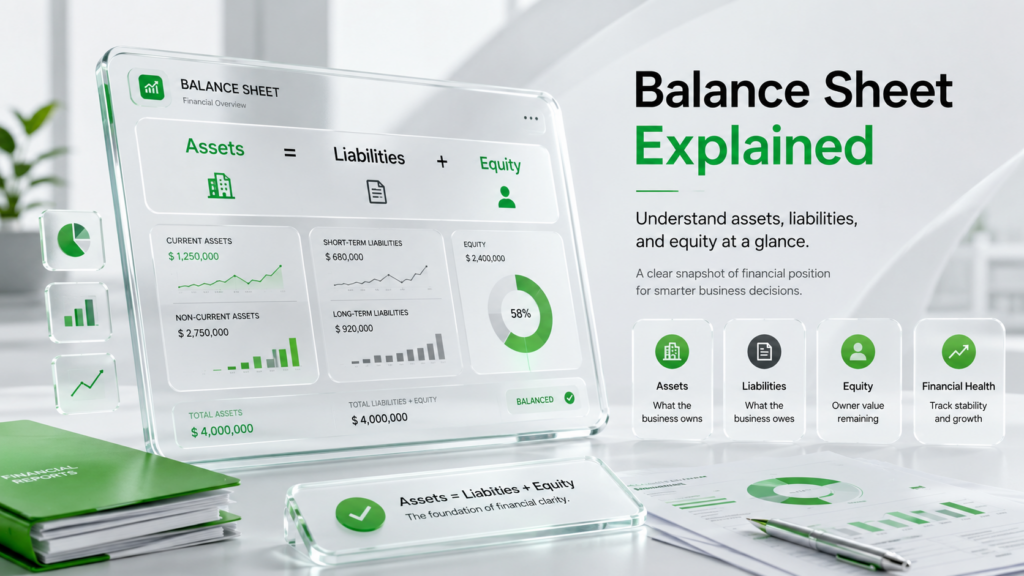
Balance Sheet Explained
A balance sheet is one of the most important financial statements used by businesses, investors, lenders, and accountants. If you’ve ever wondered how companies know what they own, what they owe, and how much value belongs to the owners, the answer is usually found in the balance sheet. Understanding this financial document helps business owners make informed decisions, improve financial planning, secure loans, and evaluate overall business performance.
Unlike an income statement that measures profitability over a period or a cash flow statement that tracks money entering and leaving the business, the balance sheet provides a snapshot of a company’s financial position at a specific point in time. Think of it as taking a financial photograph. Instead of showing movement, it captures exactly where the business stands on a given date.
Whether you’re a student learning accounting, an entrepreneur managing a startup, or someone interested in financial literacy, understanding how a balance sheet works will improve your ability to analyze financial health and make smarter business decisions.
What Is a Balance Sheet?
A balance sheet is a financial statement that summarizes a company’s assets, liabilities, and shareholders’ equity at a particular date. It follows one simple but powerful accounting equation:
Assets = Liabilities + Shareholders’ Equity
This equation ensures that every financial transaction remains balanced. Every asset owned by the company is financed either through borrowed money (liabilities) or money invested by the owners (equity).
Imagine buying a delivery truck for your business. If you pay cash, your assets decrease in cash but increase in vehicles. If you finance the truck through a bank loan, your assets increase while your liabilities increase by the same amount. No matter how the purchase happens, the balance sheet remains balanced.
Business owners rely on this document to monitor financial stability, identify risks, and prepare for future growth. Investors use it to determine whether a company is financially healthy before investing. Banks review balance sheets when deciding whether to approve business loans because they reveal the company’s ability to repay debt.
A properly prepared balance sheet follows accounting standards and presents an accurate picture of financial strength, making it one of the most trusted reports in business finance.
Why Every Business Needs a Balance Sheet
A balance sheet is far more than an accounting requirement. It is a decision-making tool that supports every major financial choice within a business. Without one, owners are often operating without a clear understanding of their financial position.
One major benefit is that it helps businesses monitor their financial health. By comparing assets with liabilities, owners can determine whether the business has enough resources to cover its obligations. A company with increasing assets and controlled liabilities is generally in a stronger financial position than one with excessive debt.
The balance sheet also plays a critical role in obtaining financing. Banks and investors examine this statement to evaluate financial stability before approving loans or investments. Strong asset growth, healthy equity, and manageable debt improve credibility and increase funding opportunities.
Business managers also use balance sheets for strategic planning. They can identify underutilized assets, reduce unnecessary liabilities, and decide when expansion is financially practical. Regular balance sheet analysis enables companies to detect financial problems early rather than reacting after issues become severe.
Understanding this statement allows business owners to make decisions based on facts instead of assumptions, reducing financial uncertainty and improving long-term success.
The Purpose of Financial Position Reporting
Financial reporting exists to provide accurate and transparent information about a business. The balance sheet is central to this purpose because it summarizes the company’s financial position at a single moment in time.
Unlike sales reports or profit reports, the balance sheet answers important questions such as:
- What does the business own?
- How much debt does it owe?
- How much value belongs to the owners?
- Can the company meet its short-term obligations?
- Is the business financially stable?
These insights help stakeholders evaluate both current performance and future potential. Investors compare balance sheets across several years to identify trends in asset growth and debt management. Creditors analyze liquidity and solvency before extending credit. Business owners monitor changes to ensure sustainable growth.
Financial reporting also supports regulatory compliance and tax preparation. Accurate balance sheets simplify audits and improve confidence among shareholders, lenders, and government authorities. For companies seeking expansion, acquisitions, or investment opportunities, a reliable balance sheet becomes an essential document that demonstrates financial discipline and transparency.
Understanding the Balance Sheet Formula
The foundation of every balance sheet is the accounting equation:
Assets = Liabilities + Shareholders’ Equity
This equation represents the relationship between everything a business owns and how those assets are financed. Every transaction affects at least two accounts, ensuring that the equation always remains balanced.
For example, if a business owner invests $100,000 into a new company, cash assets increase by $100,000 while owner’s equity also increases by $100,000. If the business later purchases equipment using a bank loan, equipment assets increase while liabilities increase by the loan amount.
Because every transaction follows this principle, accountants can prepare financial statements that remain mathematically accurate and logically consistent.
Understanding this formula makes reading financial statements much easier because every number has a clear relationship with another part of the balance sheet. Instead of viewing the report as a collection of unrelated figures, readers begin to understand the story behind the numbers and how business decisions affect financial position.
Assets
Shareholders’ Equity
Shareholders’ equity, also known as owners’ equity in a sole proprietorship or partnership, represents the residual interest in a company’s assets after all liabilities have been deducted. In simple terms, it is the amount that belongs to the business owners if every asset were sold and every debt were paid off. This section of the balance sheet is especially important because it reflects the company’s net worth from the owners’ perspective.
The formula for calculating shareholders’ equity is:
Shareholders’ Equity = Total Assets − Total Liabilities
For publicly traded companies, equity includes several components such as common stock, additional paid-in capital, retained earnings, treasury stock, and accumulated other comprehensive income. For small businesses, the equity section is usually much simpler and consists primarily of the owner’s investment and retained earnings.
Retained earnings deserve special attention because they show the cumulative profits that have been reinvested into the business instead of being distributed to shareholders. A company with steadily increasing retained earnings often demonstrates consistent profitability and disciplined financial management. Conversely, declining retained earnings may indicate recurring losses or excessive dividend payments.
A strong equity position provides several advantages. Businesses with higher equity are generally considered more financially stable, making it easier to obtain financing, attract investors, and withstand economic downturns. Equity also acts as a financial cushion during periods of reduced revenue or unexpected expenses.
It is important to remember that high equity alone does not guarantee success. Investors typically evaluate equity alongside profitability, cash flow, and debt levels to gain a complete understanding of a company’s financial condition. A balanced combination of growing equity, controlled liabilities, and productive assets usually signals long-term financial health.
How to Read a Balance Sheet
Reading a balance sheet may seem intimidating at first, but once you understand the structure, it becomes a logical process of analyzing relationships between numbers rather than memorizing accounting terminology. The key is not just to look at totals but to understand what those totals reveal about the company’s financial strength, liquidity, and long-term sustainability.
Begin by reviewing the total assets. Compare current assets with non-current assets to determine where the company’s resources are concentrated. A business with sufficient cash and receivables generally has more flexibility than one whose assets are mostly tied up in buildings or equipment. Next, examine total liabilities. Determine how much debt the company owes and whether most obligations are short-term or long-term.
After reviewing assets and liabilities, focus on shareholders’ equity. A growing equity balance over several years often indicates profitable operations and sound financial management. If equity is declining while liabilities continue to increase, it may signal financial stress.
Trend analysis is equally important. Rather than analyzing a single balance sheet, compare reports from multiple years. Questions to ask include:
- Are total assets growing?
- Is debt increasing faster than assets?
- Is equity improving over time?
- Has cash increased or decreased?
- Are inventory levels reasonable compared to sales?
Answering these questions provides valuable insight into the direction of the business. Financial statements tell a story, and the balance sheet is one of the best chapters in understanding that story.
Analyzing Liquidity
Liquidity refers to a company’s ability to meet its short-term financial obligations without experiencing financial difficulty. One of the first things investors, creditors, and financial analysts examine is whether the business has enough liquid resources to pay upcoming bills.
A commonly used liquidity measurement is the Current Ratio:
| Liquidity Ratio | Formula | Ideal Range |
|---|---|---|
| Current Ratio | Current Assets ÷ Current Liabilities | Above 1.0 |
| Quick Ratio | (Current Assets − Inventory) ÷ Current Liabilities | Around 1.0 or higher |
A current ratio above one generally indicates that current assets exceed current liabilities, suggesting the business can comfortably cover short-term obligations. However, an extremely high ratio may also indicate that cash or inventory is not being used efficiently.
Liquidity analysis helps management identify potential cash shortages before they become serious problems. Businesses with healthy liquidity can pay suppliers on time, manage payroll confidently, and respond to unexpected opportunities or emergencies without relying heavily on additional borrowing.
Measuring Solvency
While liquidity focuses on short-term financial health, solvency measures a company’s long-term ability to meet its financial commitments. Solvency analysis is especially important for lenders and investors because it indicates whether the business can continue operating successfully over many years.
One commonly used solvency ratio is the Debt-to-Equity Ratio:
Debt-to-Equity Ratio = Total Liabilities ÷ Shareholders’ Equity
A lower ratio generally indicates that the company relies more on owner investment than borrowed money, reducing financial risk. A higher ratio suggests greater dependence on debt financing, which may increase profitability during strong economic periods but also increases financial risk during downturns.
Another useful measure is the Equity Ratio, which compares shareholders’ equity to total assets. A higher equity ratio often reflects stronger financial stability and lower reliance on creditors.
No single ratio provides a complete picture. Instead, financial professionals analyze several solvency indicators together while considering industry standards. For example, utility companies often carry higher debt levels than technology firms because they invest heavily in long-term infrastructure. Context matters when interpreting these figures.
A business with strong solvency can finance growth, survive economic uncertainty, and maintain the confidence of investors and lenders alike.
Common Mistakes When Reading a Balance Sheet
Many beginners make the mistake of looking only at the bottom-line totals without understanding the underlying details. A balance sheet should never be interpreted in isolation because every number is connected to another financial statement or business activity.
One common mistake is assuming that a company with high assets is automatically successful. Assets may include slow-moving inventory, aging equipment, or unpaid customer invoices that provide little immediate financial benefit. Quality matters just as much as quantity.
Another frequent misunderstanding involves debt. Some readers believe all liabilities are harmful, but responsible borrowing often finances productive investments that generate future profits. The real concern is whether debt levels are sustainable relative to income, cash flow, and equity.
Ignoring trends is another major error. A single balance sheet provides only a snapshot. Comparing statements across several reporting periods reveals whether assets, liabilities, and equity are improving or deteriorating over time. Consistent trend analysis offers much deeper insights than evaluating one year’s figures alone.
Finally, many people overlook the importance of accompanying financial statements. The balance sheet works best when analyzed alongside the income statement and cash flow statement. Together, these reports explain not only what a business owns and owes but also how it earns money and manages cash, providing a complete picture of financial performance.
Benefits of Understanding a Balance Sheet
Financial statements serve many different audiences, each with unique goals. Understanding who uses these reports helps explain why they contain so much detailed information.
Business owners rely on financial statements to evaluate profitability, manage expenses, monitor cash flow, and plan future expansion. Investors examine them before purchasing shares because they want to identify companies capable of delivering long-term returns. Banks review financial statements to assess lending risk, while suppliers evaluate them before offering trade credit.
Government agencies also depend on financial statements to verify tax obligations and regulatory compliance. Employees may analyze financial reports to understand the stability of their employer, while potential business partners review them before entering strategic partnerships.
Because so many stakeholders depend on these reports, businesses must prepare them carefully and maintain accurate accounting records throughout the year. Learning to read financial statements allows you to interpret this information with greater confidence and make informed financial decisions regardless of your role. Learning how to interpret a balance sheet provides benefits that extend far beyond accounting. Whether you own a small business, invest in stocks, manage a nonprofit organization, or simply want to improve your financial literacy, understanding this financial statement enables you to make more informed decisions. Instead of relying on guesswork or assumptions, you can evaluate financial information using objective data and identify both opportunities and potential risks.
For business owners, a balance sheet serves as a financial dashboard. It highlights whether the company has sufficient cash to meet short-term obligations, whether debt levels remain manageable, and whether assets are being used efficiently. Regularly reviewing the balance sheet can reveal declining cash reserves, rising accounts receivable, or increasing liabilities before these issues become major financial problems. Early detection allows management to take corrective action, such as improving collections, reducing unnecessary expenses, or refinancing debt.
Balance Sheet Example
Seeing a practical example often makes the concepts much easier to understand. The simplified balance sheet below illustrates how the accounting equation works in practice.
ABC Trading Ltd.
Balance Sheet as of December 31, 2025
| Assets | Amount ($) |
|---|---|
| Cash | 40,000 |
| Accounts Receivable | 18,000 |
| Inventory | 27,000 |
| Prepaid Expenses | 5,000 |
| Total Current Assets | 90,000 |
| Property & Equipment | 160,000 |
| Less: Accumulated Depreciation | (30,000) |
| Intangible Assets | 20,000 |
| Total Non-Current Assets | 150,000 |
| Total Assets | 240,000 |
| Liabilities & Shareholders’ Equity | Amount ($) |
|---|---|
| Accounts Payable | 22,000 |
| Short-Term Loan | 18,000 |
| Accrued Expenses | 10,000 |
| Total Current Liabilities | 50,000 |
| Long-Term Bank Loan | 70,000 |
| Total Liabilities | 120,000 |
| Owner’s Capital | 80,000 |
| Retained Earnings | 40,000 |
| Total Shareholders’ Equity | 120,000 |
| Total Liabilities & Equity | 240,000 |
Notice that:
Total Assets = Total Liabilities + Shareholders’ Equity
$240,000 = $120,000 + $120,000
This example demonstrates why the statement is called a balance sheet—both sides always balance. If the numbers do not match, it usually indicates an accounting error that needs investigation.
Now let’s interpret the information.
The company has $90,000 in current assets compared to $50,000 in current liabilities, suggesting it has sufficient short-term resources to cover upcoming obligations. It also owns substantial long-term assets, indicating investment in business operations and future growth. Total liabilities represent exactly half of total assets, while shareholders’ equity finances the remaining half. This balanced capital structure suggests reasonable financial stability, although a complete evaluation would also consider profitability, cash flow, and industry benchmarks.
If this company continues increasing assets and retained earnings while keeping liabilities under control, its financial position is likely to strengthen over time. This simple example illustrates how the balance sheet provides valuable insights without requiring advanced accounting knowledge.
Conclusion
A balance sheet is much more than a mandatory financial report it is one of the most valuable tools for understanding a company’s financial health. By organizing assets, liabilities, and shareholders’ equity into a structured format, it provides a clear snapshot of what a business owns, what it owes, and the value remaining for its owners. This information helps business leaders make informed decisions, supports investors in evaluating opportunities, and enables lenders to assess financial risk with confidence.
Mastering balance sheet analysis does not require becoming an accountant. Once you understand the accounting equation and the relationship between assets, liabilities, and equity, financial statements become significantly easier to interpret. Over time, comparing balance sheets across multiple reporting periods reveals trends that support better planning, stronger budgeting, and more effective financial management.
Whether you are launching a startup, managing an established company, studying accounting, or investing in businesses, learning how to read and analyze a balance sheet is an essential financial skill. Combined with the income statement and cash flow statement, it forms the foundation of sound financial analysis and long-term business success.
Frequently Asked Questions
1. What is the main purpose of a balance sheet?
The primary purpose of a balance sheet is to show a company’s financial position at a specific point in time by listing its assets, liabilities, and shareholders’ equity. It helps stakeholders evaluate financial stability and make informed decisions.
2. Why is the balance sheet always balanced?
The balance sheet follows the accounting equation:
Assets = Liabilities + Shareholders’ Equity
Every business transaction affects at least two accounts, ensuring that both sides of the equation remain equal.
3. What is the difference between current and non-current assets?
Current assets are expected to be converted into cash or used within one year, while non-current assets provide long-term value and are typically used for more than one year.
4. Can a company be profitable but still have a weak balance sheet?
Yes. A business may generate profits but still struggle with excessive debt, poor liquidity, or insufficient cash. This is why investors analyze the balance sheet alongside the income statement and cash flow statement.
5. How often should businesses prepare a balance sheet?
Most businesses prepare balance sheets monthly, quarterly, and annually. Regular preparation allows management to monitor financial performance, identify trends, and make timely strategic decisions.