
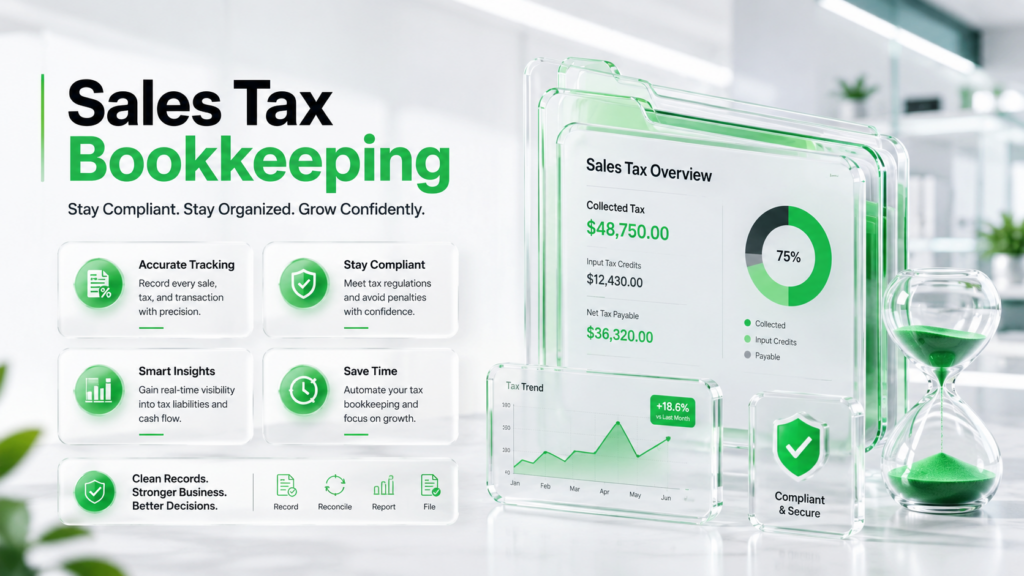
Sales Tax Bookkeeping
Sales tax bookkeeping plays a vital role in keeping every business financially organized and compliant with tax regulations. Whether you operate a small retail shop, an eCommerce store, or a growing company, accurately tracking the sales tax you collect and pay helps you avoid costly mistakes, late filing penalties, and unnecessary audits. A well-maintained bookkeeping system also gives you a clear picture of your cash flow, allowing you to make smarter financial decisions throughout the year.
Many business owners assume bookkeeping only involves recording income and expenses, but sales tax requires extra attention. Since the tax collected from customers does not belong to the business, it must be recorded separately as a liability until it is remitted to the appropriate tax authority. Likewise, businesses may be able to claim eligible tax credits on qualifying purchases, making accurate recordkeeping even more important. Understanding these principles helps ensure your financial statements remain accurate while simplifying tax reporting.
This guide explains everything you need to know about sales tax bookkeeping, from recording daily transactions and maintaining the correct ledger accounts to reconciling tax balances and filing returns accurately. You will also learn about common bookkeeping mistakes, practical best practices, and accounting software that can automate much of the process. By the end of this guide, you’ll have a solid understanding of how to manage sales tax efficiently and keep your business compliant while supporting long-term growth.
What Is Sales Tax Bookkeeping?
Sales tax bookkeeping is one of the most important financial processes for businesses that sell taxable products or services. Instead of treating collected tax as business income, companies record it separately as a liability because the money ultimately belongs to the tax authority. This simple accounting principle helps businesses maintain accurate financial records, prepare tax returns with confidence, and reduce the risk of costly penalties during audits. Whether you operate a small retail shop, an online store, or a growing wholesale business, maintaining organized sales tax bookkeeping records creates a reliable financial foundation for every business decision.
Many business owners focus only on tracking sales and expenses while overlooking tax records until filing deadlines arrive. Unfortunately, that approach often creates confusion, missing invoices, and incorrect tax calculations. By recording every taxable transaction as it happens, businesses can monitor exactly how much tax they collect, how much input tax they can claim where applicable, and how much remains payable. According to current tax guidance, businesses should reconcile sales tax regularly rather than waiting until the filing date because consistent reconciliation significantly reduces reporting errors and audit risks.
Why Every Business Needs Accurate Sales Tax Records
Many entrepreneurs believe bookkeeping is simply about knowing whether they made a profit. In reality, tax bookkeeping serves an entirely different purpose. Every invoice, receipt, and purchase document contributes to the accuracy of your tax records. If these documents are incomplete or recorded incorrectly, the final tax liability may also be inaccurate.
Accurate sales tax bookkeeping offers several important benefits. First, it helps businesses comply with local tax laws and filing deadlines. Second, it reduces the possibility of paying too much tax because eligible tax credits or deductible purchases become easier to identify. Third, organized records save countless hours during tax season because accountants no longer need to search through months of transactions.
Current guidance from tax authorities emphasizes maintaining complete transaction records, invoices, customer information, and purchase documentation to support tax returns. Businesses that reconcile these records monthly generally experience fewer filing issues and lower audit exposure.
Accurate records also improve decision-making. When business owners know exactly how much tax they owe, they can manage cash flow more effectively instead of facing unexpected liabilities. That confidence becomes especially valuable as the business expands into new markets or introduces additional taxable products.
How Sales Tax Bookkeeping Works
At first glance, sales tax bookkeeping may seem complicated because every transaction includes both revenue and tax. However, the process becomes much simpler once you understand the accounting logic behind it.
Whenever a taxable sale occurs, the customer pays two amounts. The first amount represents your actual revenue from selling the product or service. The second amount represents sales tax collected on behalf of the government. Since the business does not own that tax money, accountants record it in a separate liability account instead of recognizing it as income.
Likewise, many businesses also pay tax when purchasing inventory or business supplies. Depending on the country’s tax system, this purchase tax may qualify as an input tax credit that reduces the final amount payable. Maintaining separate records for output tax collected and input tax paid ensures accurate calculations when preparing tax returns. Tax regulations in many jurisdictions, including Pakistan’s federal sales tax framework, continue to require businesses to distinguish taxable supplies, exempt supplies, zero-rated supplies, and input adjustments.
Another important aspect involves reconciliation. Every month, businesses compare bookkeeping records with invoices, bank deposits, accounting software reports, and tax summaries. Any differences should be investigated immediately rather than postponed until year-end. This proactive approach not only strengthens compliance but also improves financial reporting throughout the year.
Understanding Taxable and Non-Taxable Sales
One of the most common bookkeeping errors occurs when businesses fail to distinguish taxable sales from non-taxable transactions. Although every sale increases revenue, not every sale attracts sales tax. Certain products, services, exports, or exempt goods may receive different tax treatment depending on applicable regulations.
Because of this variation, accountants create separate categories within the bookkeeping system. Taxable sales are recorded with the applicable sales tax, while exempt or zero-rated transactions remain separate. Keeping these categories distinct simplifies tax return preparation and minimizes calculation errors.
Imagine operating an online business that sells both taxable electronics and tax-exempt educational materials. If every sale were combined into one revenue account without proper classification, calculating tax liabilities later would become extremely difficult. Instead, modern bookkeeping software allows each invoice to specify the appropriate tax treatment automatically, significantly reducing manual work and improving reporting accuracy.
Businesses expanding into multiple locations should pay even closer attention because tax rules may differ across regions. Community discussions among professional bookkeepers consistently identify multi-jurisdiction sales tax as one of the most challenging bookkeeping responsibilities, making accurate transaction categorization essential from the very beginning.
Input Tax vs. Output Tax
Understanding the difference between input tax and output tax is essential for accurate sales tax bookkeeping. These two terms determine how much tax your business ultimately owes to the tax authority. Although they are closely related, they represent two very different types of transactions, and confusing them can lead to reporting errors or penalties.
Output tax is the sales tax your business collects from customers when selling taxable products or services. This money is not business income. Instead, you hold it temporarily until it is time to file and pay your sales tax return. Every taxable invoice should clearly show the amount of output tax collected so it can be recorded in the Sales Tax Liability account.
Input tax, on the other hand, is the tax your business pays when purchasing goods or services for business use. Depending on your country’s tax regulations, you may be able to claim this amount as a credit against the output tax you collected. Keeping accurate purchase invoices is critical because tax authorities often require proper documentation before allowing businesses to claim input tax credits.
Think of these two taxes as opposite sides of the same coin. Output tax increases your liability, while eligible input tax reduces it. Good sales tax bookkeeping keeps these amounts separate throughout the accounting period so that filing your tax return becomes straightforward instead of stressful.
Sales Tax Bookkeeping Accounts You Should Maintain
A well-organized chart of accounts is the backbone of effective sales tax bookkeeping. Every transaction should flow into the correct account, allowing you to generate accurate reports whenever needed. Without clearly defined accounts, financial statements become confusing, and tax calculations become unreliable.
The most common accounts include:
| Account | Purpose | Typical Balance |
|---|---|---|
| Sales Revenue | Records income from product or service sales | Credit |
| Sales Tax Liability | Tracks sales tax collected from customers | Credit |
| Accounts Receivable | Records customer balances awaiting payment | Debit |
| Cash/Bank | Records money received | Debit |
| Purchases or Cost of Goods Sold | Tracks inventory and business purchases | Debit |
| Input Tax (where applicable) | Records tax paid on eligible business purchases | Debit |
Maintaining these accounts separately provides several advantages. First, it becomes much easier to reconcile monthly tax reports. Second, accountants can identify discrepancies before filing deadlines. Third, financial statements present a more accurate picture of business performance because sales tax does not inflate revenue figures.
Sales Revenue Account
The Sales Revenue account records only the value of products or services sold. It should never include the sales tax collected from customers because that tax is not earned income. Separating revenue from tax ensures that profit reports reflect the true performance of the business.
For example, suppose you sell a product for $100 and charge $10 in sales tax. Your accounting entry should record:
- Sales Revenue: $100
- Sales Tax Liability: $10
- Cash or Accounts Receivable: $110
Recording the full $110 as revenue would overstate income and create incorrect financial statements. Accurate sales tax bookkeeping prevents this common mistake by keeping tax separate from operational earnings.
Sales Tax Liability Account
The Sales Tax Liability account represents money your business owes to the government. Every taxable sale increases this liability, while each tax payment decreases it.
Business owners sometimes mistakenly spend the collected tax because it appears in the bank account alongside business income. That approach often creates cash-flow problems when the filing deadline arrives. Instead, many experienced accountants recommend setting aside collected tax in a separate bank reserve or carefully monitoring the liability account throughout the reporting period.
Reviewing this account monthly also helps identify unusual fluctuations. If collected tax suddenly drops despite increasing sales, it may indicate incorrect tax coding or missing transactions that require immediate attention.
Purchase Tax Records
Purchase records play a major role in sales tax bookkeeping, especially in jurisdictions that allow businesses to recover eligible input tax. Every purchase invoice should include the supplier’s details, invoice number, purchase amount, tax amount, and payment information.
Maintaining complete purchase documentation offers multiple benefits. It supports tax credit claims, simplifies audits, and improves expense tracking. Digital document storage has become increasingly popular because it reduces paperwork while making invoices easy to retrieve whenever needed.
Businesses should also establish a consistent review process to confirm that every purchase has been entered accurately. Missing invoices or duplicated entries can distort both expense reports and tax calculations, leading to unnecessary adjustments during filing.
Step-by-Step Sales Tax Bookkeeping Process
A structured bookkeeping process reduces errors and keeps financial records organized throughout the year. Instead of waiting until tax season, successful businesses update their books regularly. This habit not only improves compliance but also provides better financial insight for daily decision-making.
The following workflow forms the foundation of reliable sales tax bookkeeping:
- Record every taxable sale immediately.
- Record all eligible business purchases.
- Verify tax codes and classifications.
- Reconcile bookkeeping records with bank statements and invoices.
- Review the Sales Tax Liability account.
- Prepare and file the sales tax return before the deadline.
- Pay any outstanding tax liability.
- Archive supporting documents for future reference.
Following these steps consistently creates an organized accounting system that remains accurate throughout the financial year. Businesses that maintain this routine generally spend far less time correcting bookkeeping errors during tax season.
Recording Sales Transactions
Every sales transaction should be recorded as soon as it occurs. Waiting several days or weeks increases the risk of forgotten invoices and incorrect tax calculations.
A complete sales entry typically includes:
- Invoice number
- Customer information
- Product or service description
- Taxable amount
- Sales tax collected
- Payment status
- Payment method
Modern accounting software can automate much of this process by generating invoices, calculating tax automatically, and updating ledger accounts simultaneously. Even with automation, regular reviews remain essential because software depends on accurate initial configuration.
Businesses handling hundreds of daily transactions often benefit from daily reconciliations rather than monthly reviews. Smaller businesses may find weekly bookkeeping sufficient, provided every transaction is entered promptly.
Recording Purchases
Purchases deserve the same level of attention as sales. Every supplier invoice should be entered into the accounting system with the correct tax treatment.
Accurate purchase recording helps businesses:
- Track operating expenses.
- Support input tax claims where applicable.
- Improve inventory management.
- Produce reliable financial statements.
- Simplify annual audits.
Organizing invoices digitally also reduces administrative workload. Many accounting applications allow users to upload invoice images directly from a smartphone, making recordkeeping faster and more efficient while minimizing the risk of lost documents.
Reconciling Sales Tax
Reconciling your records is one of the most valuable habits you can develop for accurate sales tax bookkeeping. Reconciliation means comparing your accounting records with bank statements, invoices, payment reports, and tax summaries to ensure everything matches. Even a small error, such as a duplicated invoice or an incorrectly applied tax rate, can affect your tax return. By reviewing your records regularly, you can identify discrepancies early and correct them before they become larger problems.
A monthly reconciliation process usually works well for most small and medium-sized businesses, while companies with a high transaction volume may benefit from weekly reconciliation. During this review, compare total taxable sales with the sales recorded in your accounting software. Next, verify that every purchase invoice has been entered correctly and that any eligible input tax has been recorded. Finally, confirm that the balance in the Sales Tax Liability account matches the amount you expect to pay based on your sales activity.
Another important step is checking customer refunds, discounts, and credit notes. These transactions often affect the amount of sales tax owed, and failing to record them correctly can result in overpaying or underpaying tax. Businesses should also review any manual journal entries because these are more likely to contain errors than automatically generated transactions.
Filing Sales Tax Returns
Once your records are complete and reconciled, the next step in sales tax bookkeeping is preparing and filing your sales tax return. Filing requirements vary depending on your country or state, but the overall process follows a similar pattern. Businesses calculate total taxable sales, determine the amount of sales tax collected, subtract any eligible input tax credits where applicable, and pay the remaining balance to the tax authority.
Preparation starts with reviewing your bookkeeping reports. Verify that taxable and non-taxable sales have been classified correctly and ensure all invoices are included. Double-check tax rates, customer exemptions, and adjustments such as returns or credit notes. Taking time to verify these details helps reduce the likelihood of filing errors.
Submitting returns on time is equally important. Late filings may result in penalties, interest charges, or additional compliance reviews. Creating a tax calendar with filing deadlines and payment reminders is a practical way to stay organized. Many accounting platforms also provide automated reminders and generate tax reports, making the filing process much easier.
Common Sales Tax Bookkeeping Mistakes
Even experienced business owners can make bookkeeping mistakes, but recognizing the most common issues can help you avoid them. Many errors occur because businesses focus on sales while overlooking the tax implications of those transactions.
Some of the most frequent mistakes include:
| Mistake | Potential Impact | How to Avoid It |
|---|---|---|
| Recording sales tax as revenue | Overstated income | Use a separate Sales Tax Liability account |
| Applying the wrong tax rate | Incorrect tax payments | Review tax settings regularly |
| Missing purchase invoices | Lost input tax credits | Keep digital copies of every invoice |
| Failing to reconcile monthly | Undetected bookkeeping errors | Schedule regular reconciliations |
| Filing tax returns late | Penalties and interest | Set reminders and maintain a tax calendar |
| Ignoring refunds and credit notes | Incorrect tax liability | Record every adjustment promptly |
Avoiding these mistakes requires consistency rather than complexity. A clear bookkeeping process, regular reviews, and reliable accounting software significantly reduce the chance of errors.
Best Software for Sales Tax Bookkeeping
Technology has transformed sales tax bookkeeping, making it faster, more accurate, and less time-consuming. Instead of calculating tax manually, businesses can rely on accounting software to automate repetitive tasks while maintaining organized records.
Some of the most popular accounting solutions include:
| Software | Best For | Key Features |
|---|---|---|
| QuickBooks Online | Small and medium businesses | Automated tax calculations, invoicing, reporting |
| Xero | Growing businesses | Bank reconciliation, tax tracking, cloud accounting |
| Zoho Books | Small businesses | Automation, expense tracking, tax reports |
| Sage Accounting | Established businesses | Financial reporting, compliance tools |
| FreshBooks | Freelancers and service businesses | Invoicing, expense management, simple bookkeeping |
When choosing software, consider factors such as business size, transaction volume, integration with payment platforms, reporting capabilities, and ease of use. Cloud-based solutions offer additional benefits because they provide secure backups, remote access, and automatic software updates.
Although automation saves time, it should support not replace good bookkeeping habits. Regularly reviewing reports, verifying tax settings, and reconciling transactions remain essential parts of effective sales tax bookkeeping.
Sales Tax Bookkeeping Best Practices
Building strong bookkeeping habits helps businesses remain compliant while improving financial visibility. Instead of treating bookkeeping as a task performed only during tax season, successful companies make it part of their daily operations.
Here are several proven best practices:
- Record every transaction as soon as it occurs.
- Separate business and personal finances.
- Reconcile accounts every month.
- Keep digital copies of invoices and receipts.
- Review tax rates whenever regulations change.
- Monitor the Sales Tax Liability account regularly.
- Use reliable accounting software.
- Back up financial records securely.
- Consult a qualified accountant for complex tax situations.
- Review financial reports monthly to identify unusual trends.
Following these practices creates a bookkeeping system that supports both compliance and business growth. Organized records improve decision-making, simplify audits, and reduce the stress associated with tax deadlines. Over time, disciplined sales tax bookkeeping becomes a valuable business asset rather than an administrative burden.
Conclusion
Accurate sales tax bookkeeping is far more than a compliance requirement it is a critical component of sound financial management. Recording transactions correctly, separating sales tax from revenue, maintaining organized purchase records, and reconciling accounts regularly all contribute to reliable financial reporting. Businesses that invest time in proper bookkeeping are better prepared for tax filings, audits, and future growth.
Whether you operate a small local business or a rapidly expanding online store, developing a consistent bookkeeping routine will save time, reduce errors, and improve cash flow management. By combining disciplined recordkeeping with modern accounting software and regular reviews, you can confidently manage your sales tax obligations while focusing on growing your business.
Frequently Asked Questions
1. What is sales tax bookkeeping?
Sales tax bookkeeping is the process of recording, tracking, reconciling, and reporting sales tax collected from customers and, where applicable, sales tax paid on eligible business purchases.
2. Why is sales tax bookkeeping important?
It helps businesses comply with tax regulations, prepare accurate tax returns, avoid penalties, maintain organized financial records, and improve cash flow management.
3. How often should sales tax bookkeeping be updated?
Businesses should record transactions daily whenever possible and reconcile their records at least once a month. High-volume businesses may benefit from weekly reconciliations.
4. Can accounting software automate sales tax bookkeeping?
Yes. Most modern accounting platforms automatically calculate sales tax, generate reports, track liabilities, and simplify reconciliation. Regular review is still necessary to ensure accuracy.
5. What documents should I keep for sales tax bookkeeping?
Keep sales invoices, purchase invoices, receipts, bank statements, tax returns, payment confirmations, and any supporting documentation required by your tax authority. Store these records securely for the period required by applicable regulations.