
Financial Record Keeping Requirements
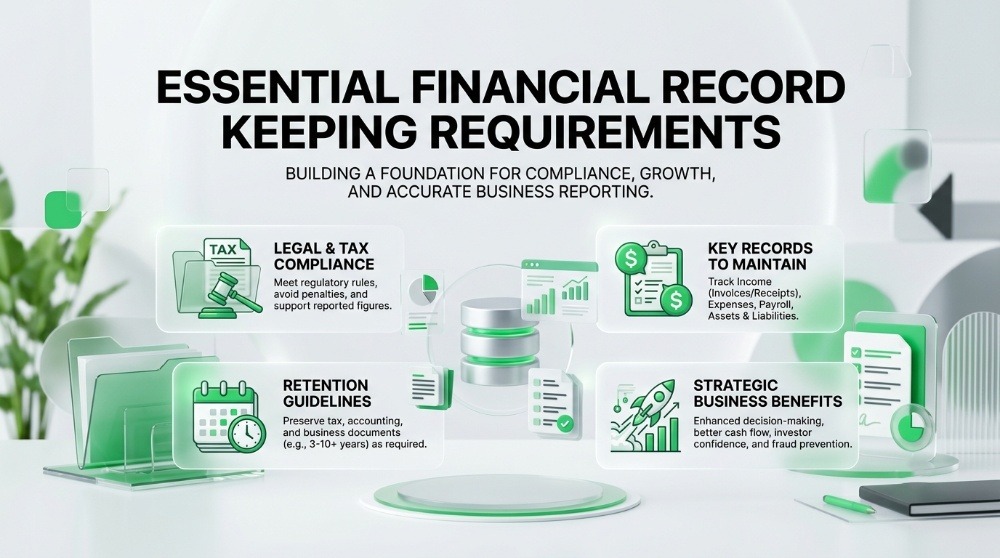
Financial record keeping requirements are the rules, practices, and legal standards that businesses must follow to accurately document every financial transaction. Whether you operate a startup, a small business, or a large corporation, maintaining complete financial records is essential for tax compliance, financial reporting, business planning, and regulatory obligations. These requirements ensure that income, expenses, assets, liabilities, payroll, inventory, and other financial activities are properly recorded and can be verified whenever necessary. Without organized financial records, businesses may struggle to prepare accurate financial statements, claim legitimate tax deductions, secure financing, or respond successfully to audits. In today’s digital business environment, governments and regulatory agencies increasingly encourage electronic record keeping because it improves accuracy, enhances security, and simplifies long-term document management.
Understanding Financial Record Keeping
Every successful business, regardless of its size, depends on accurate and organized financial records. Whether you operate a local retail store, manage an online business, or work as a freelancer, maintaining proper documentation of your financial activities is not simply an accounting task it is one of the foundations of responsible business management. Financial records tell the complete story of your company’s income, expenses, assets, liabilities, and overall financial health. Without them, preparing tax returns, applying for loans, attracting investors, or making informed business decisions becomes far more difficult than necessary.
Many entrepreneurs underestimate the importance of financial record keeping requirements until they face a tax audit or discover that missing documents make it impossible to verify expenses or revenue. Modern accounting regulations across many countries increasingly encourage businesses to maintain digital records because electronic systems reduce errors, improve accessibility, and strengthen security. Government agencies also expect businesses to maintain records that accurately support every transaction reported on tax returns. This requirement applies whether records are stored in paper files or cloud-based accounting software. Businesses that establish organized record keeping procedures from the beginning save countless hours during tax season while significantly reducing compliance risks.
What Financial Records Include
Financial records consist of every document that demonstrates how money enters and leaves a business. These records provide evidence of commercial transactions and create a transparent history that accountants, auditors, lenders, investors, and government agencies can review whenever necessary. A complete record keeping system includes invoices, purchase receipts, sales records, payroll documentation, bank statements, tax returns, contracts, loan agreements, inventory reports, depreciation schedules, and supporting documentation for business deductions.
Think of financial records as the memory of your business. Just as people rely on memories to make informed decisions, organizations depend on accurate records to evaluate performance and plan for future growth. Missing documentation can create confusion about cash flow, profitability, and tax obligations. Businesses using modern accounting software often automate much of this process, allowing invoices, receipts, and bank transactions to synchronize automatically while maintaining a searchable archive. Even with automation, owners remain responsible for ensuring records are complete, accurate, and retained according to applicable legal requirements.
Why Proper Record Keeping Matters
Accurate financial records serve far more purposes than preparing annual tax returns. They allow business owners to monitor profitability, identify unnecessary spending, forecast future cash flow, manage budgets, and evaluate whether strategic decisions are producing positive financial results. Reliable financial information also strengthens credibility when applying for financing because lenders typically request several years of financial statements before approving loans or lines of credit.
Proper record keeping also protects businesses during regulatory reviews and tax examinations. According to current IRS guidance, taxpayers are responsible for maintaining sufficient documentation to support income, deductions, and credits reported on tax returns. Businesses should preserve records for the period during which tax authorities may examine returns, while certain documents—such as those relating to property or employment taxes—must often be retained for longer periods. Electronic recordkeeping systems are acceptable provided they accurately preserve information and remain accessible when requested. Developing consistent record keeping habits today prevents costly disputes, penalties, and administrative headaches in the future while giving management confidence that financial decisions are based on reliable information.
Legal Requirements for Financial Records
Every country establishes legal standards governing how businesses must maintain their financial records. Although specific regulations differ by jurisdiction, the underlying principle remains consistent: financial information must be accurate, complete, verifiable, and available for inspection when required. Financial record keeping requirements exist to promote transparency, prevent fraud, ensure accurate tax reporting, and protect both businesses and consumers. Organizations that fail to maintain proper records may face financial penalties, legal disputes, delayed audits, or reputational damage. Understanding these legal obligations is therefore an essential responsibility for every business owner, accountant, and financial manager.
Business Compliance Standards
Business compliance standards require organizations to maintain financial records that accurately reflect every aspect of their operations. These standards extend beyond tax reporting and include payroll administration, employee benefits, inventory management, accounts payable, accounts receivable, asset management, and financial reporting. Public companies often face stricter reporting obligations than privately owned businesses, but all organizations benefit from maintaining organized financial documentation. Accurate records support regulatory filings, internal audits, insurance claims, and legal proceedings while demonstrating that the business operates responsibly.
Compliance also involves establishing internal policies that define how financial records are created, reviewed, stored, and protected. Businesses should assign responsibility for record maintenance, implement approval procedures for financial transactions, and perform regular reconciliations between accounting records and bank statements. Access to sensitive financial information should be restricted to authorized personnel to reduce the risk of fraud or accidental data loss. As businesses grow, documented procedures become increasingly valuable because they ensure consistency across departments and make employee training more effective. A well-designed compliance program transforms financial record keeping from a routine administrative task into a strategic component of corporate governance.
Tax Authority Expectations
Tax authorities expect businesses to maintain sufficient documentation to support every figure reported on tax returns. Income must be backed by invoices, sales records, and bank deposits, while expenses should be supported by receipts, supplier invoices, contracts, or payment confirmations. Payroll taxes require detailed employee records, wage calculations, and tax withholding documentation. Businesses that cannot provide supporting evidence during an audit may have deductions disallowed or face additional tax assessments, interest, and penalties. This makes compliance with financial record keeping requirements essential for minimizing tax-related risks.
Businesses should also establish a document retention policy that aligns with applicable tax laws. Certain records, such as tax returns, payroll documents, property records, and supporting schedules, may need to be retained for several years depending on legal requirements. Electronic backups add another layer of protection by ensuring records remain available even if physical documents are damaged or lost. Regular reviews of accounting files help identify missing documents before they become compliance issues. By maintaining complete and organized tax records throughout the year rather than waiting until filing season, businesses simplify reporting, improve accuracy, and strengthen their ability to respond confidently to regulatory inquiries.
Essential Financial Documents Every Business Should Keep
Every successful business relies on a well-organized collection of financial documents that accurately record its daily operations. Maintaining these documents is not simply about satisfying accountants or preparing for tax season; it is a core part of meeting financial record keeping requirements and ensuring the long-term stability of the business. Each financial document tells a different part of the company’s financial story, from tracking revenue and expenses to monitoring assets and payroll obligations. When these records are complete and properly organized, they provide valuable insights into business performance, support informed decision-making, and protect the organization during audits or legal disputes.
As businesses grow, the volume of financial documents increases significantly. Without a structured filing system, important records can easily become misplaced or overlooked. Modern accounting software simplifies document management by automatically attaching receipts, invoices, and bank transactions to accounting entries, making information easier to locate whenever needed. Even businesses that rely on digital systems should establish document management policies that specify who is responsible for creating, reviewing, storing, and backing up financial records. Consistently following financial record keeping requirements helps businesses reduce administrative errors, improve financial transparency, and build trust with investors, lenders, suppliers, and regulatory authorities.
Income Records
Income records document every source of revenue generated by a business. These records are among the most important financial documents because they directly affect profitability, tax reporting, and financial analysis. Every payment received should be supported by clear documentation showing the amount, date, customer information, payment method, and purpose of the transaction. Whether income comes from product sales, professional services, rental income, subscriptions, or investments, maintaining complete records ensures that revenue is reported accurately and consistently.
Expense Documentation
Every business incurs expenses while generating revenue, making expense documentation equally important as income records. Recording business expenses accurately allows organizations to understand operating costs, manage budgets effectively, and claim legitimate tax deductions. Every purchase, whether large or small, should be supported by documentation that clearly identifies the supplier, purchase date, amount paid, items purchased, and business purpose. Missing receipts or incomplete documentation may result in denied tax deductions or inaccurate financial statements, potentially affecting profitability and compliance.
Expense documentation typically includes supplier invoices, purchase receipts, utility bills, rent agreements, travel expenses, maintenance costs, insurance premiums, loan interest statements, subscription invoices, fuel receipts, office supply purchases, and payment confirmations. Businesses should reconcile these documents regularly with bank statements and credit card transactions to identify errors or unauthorized expenses. Digital receipt management applications have made this process significantly easier by allowing users to scan receipts immediately after purchase and store them securely in cloud-based accounting systems. Following financial record keeping requirements through accurate expense documentation not only improves tax compliance but also provides management with reliable information for controlling costs and improving operational efficiency.
Payroll Records
Payroll records represent one of the most sensitive categories of financial documentation because they involve employee compensation, tax withholdings, statutory deductions, and employment benefits. Businesses with employees are legally required to maintain detailed payroll information demonstrating that wages have been calculated correctly and that all required deductions have been withheld and remitted to the appropriate government agencies. Accurate payroll documentation protects both employers and employees by ensuring transparency, compliance, and accountability throughout the payroll process.
Asset and Inventory Records
Asset and inventory records help businesses monitor the resources they own and use to generate income. Fixed assets such as buildings, machinery, vehicles, computers, furniture, and equipment represent significant investments that require accurate documentation throughout their useful lives. Inventory records track products available for sale or materials used in production, allowing businesses to manage stock efficiently and avoid costly shortages or overstock situations. Without reliable asset and inventory records, financial statements may become inaccurate, insurance claims may be delayed, and business decisions may be based on incomplete information.
Comparison of Essential Financial Records
| Financial Record | Primary Purpose | Examples | Business Benefit |
|---|---|---|---|
| Income Records | Track business revenue | Sales invoices, receipts, bank deposits | Accurate revenue reporting and forecasting |
| Expense Records | Monitor operating costs | Purchase receipts, utility bills, supplier invoices | Better budgeting and tax deductions |
| Payroll Records | Record employee compensation | Payroll reports, tax forms, salary records | Payroll compliance and employee transparency |
| Asset Records | Track long-term business assets | Equipment invoices, depreciation schedules | Accurate financial statements and asset management |
| Inventory Records | Monitor stock levels | Inventory reports, purchase orders, stock counts | Efficient inventory control and reduced losses |
The table above illustrates how each category of financial documentation serves a distinct purpose while contributing to the overall financial health of a business. Collectively, these records form the backbone of an effective accounting system and ensure compliance with financial record keeping requirements. Businesses that maintain these documents consistently are better equipped to prepare financial reports, satisfy regulatory obligations, and make informed strategic decisions based on reliable financial information.
How Long Should Financial Records Be Retained?
One of the most frequently asked questions by business owners is how long financial documents should be kept. The answer depends on the type of record, the laws that apply in the country where the business operates, and the purpose of the document. While there is no universal retention period that applies worldwide, every business should establish a document retention policy that complies with local tax regulations and industry requirements. Following financial record keeping requirements means retaining financial documents long enough to support tax returns, resolve legal disputes, satisfy audit requests, and provide historical financial information when needed.
Destroying financial records too early can expose a business to significant risks. If tax authorities request documentation that has already been discarded, businesses may be unable to verify reported income or claimed deductions. Likewise, keeping unnecessary records forever can create storage challenges and increase administrative costs. A balanced retention policy helps businesses preserve important documents while securely disposing of records that have exceeded their legal retention period. Companies should also review their retention policies periodically to ensure they remain aligned with changing regulations and technological developments.
General Retention Periods
Although exact retention requirements vary by jurisdiction, several general guidelines are widely accepted by accountants and financial professionals. Tax returns, supporting schedules, invoices, payroll records, bank statements, contracts, and financial statements should typically be retained for several years after filing or completion. Property and asset records should often be kept until the asset is sold or disposed of, along with additional years if required by tax regulations. Employment-related documents may also require longer retention periods because labor laws often differ from tax laws.
Instead of relying on memory, businesses should develop a written retention schedule that identifies each document type and specifies how long it should be stored. This policy should also define when records may be securely destroyed and who is responsible for authorizing disposal. Cloud-based document management systems simplify retention by automatically organizing files according to document categories and preserving backup copies in secure locations. Maintaining records according to financial record keeping requirements not only strengthens legal compliance but also provides valuable historical information for financial planning, trend analysis, and future business decisions.
Digital vs. Paper Storage
Technology has transformed the way businesses manage financial records. While paper documents remain legally acceptable in many jurisdictions, digital record keeping has become the preferred approach because it improves efficiency, reduces storage costs, and makes information accessible from virtually anywhere. Electronic accounting systems allow businesses to scan invoices, attach receipts directly to transactions, automate bank reconciliations, and retrieve documents within seconds. This level of organization significantly improves productivity while supporting compliance with financial record keeping requirements.
Despite the advantages of digital storage, businesses must implement strong security measures to protect sensitive financial information. Regular backups, encrypted storage, multi-factor authentication, secure user permissions, and disaster recovery plans help prevent data loss and unauthorized access. Paper records also require protection through fire-resistant filing systems and secure storage environments. Many organizations adopt a hybrid approach by maintaining original legal documents in paper form while storing scanned copies electronically for daily operations. Regardless of the storage method chosen, the primary objective is ensuring that records remain accurate, complete, secure, and easily accessible throughout the required retention period.
Best Practices for Financial Record Management
Maintaining financial records is not simply about collecting receipts and filing invoices. Effective financial record management requires consistent procedures, reliable technology, trained personnel, and regular monitoring. Businesses that establish standardized processes reduce errors, improve reporting accuracy, and spend less time correcting bookkeeping mistakes. Following best practices also supports stronger compliance with financial record keeping requirements, making audits, tax preparation, and financial reporting significantly more efficient.
A successful record management system begins with consistency. Every transaction should be recorded promptly, supported by appropriate documentation, reviewed for accuracy, and securely stored. Monthly reconciliations between accounting records and bank statements help identify discrepancies before they become major problems. Businesses should also establish clear responsibilities so employees understand who creates, approves, reviews, and archives financial documents. These practices strengthen internal accountability while improving the overall quality of financial information available to management.
Choosing Accounting Software
Modern accounting software has revolutionized financial record management by automating many routine bookkeeping tasks. Instead of manually entering every transaction, businesses can synchronize bank accounts, generate invoices, monitor expenses, calculate taxes, produce financial reports, and securely store supporting documents within a single platform. Automation reduces human error while allowing business owners to spend more time focusing on growth rather than administrative work.
Internal Controls
Internal controls are policies and procedures designed to safeguard financial assets and ensure the accuracy of accounting records. Even small businesses benefit from implementing basic controls that reduce the risk of fraud, unauthorized transactions, and accounting errors. Strong internal controls create accountability by separating financial responsibilities among employees and requiring approvals for significant transactions.
Common Record Keeping Mistakes
Many businesses encounter financial difficulties not because they lack revenue but because they fail to maintain accurate financial records. Small bookkeeping errors often accumulate over time, leading to inaccurate financial statements, missed tax deductions, cash flow problems, and regulatory penalties. Understanding common mistakes helps business owners improve their accounting practices and reduce unnecessary risks.
Some of the most frequent record-keeping mistakes include delaying transaction recording, failing to retain supporting receipts, mixing personal and business expenses, neglecting regular bank reconciliations, ignoring inventory discrepancies, failing to back up digital records, overlooking payroll documentation, and relying solely on spreadsheets without adequate controls. Another common mistake is waiting until tax season to organize financial documents, which often results in missing information and unnecessary stress. Businesses that review their records regularly and correct errors promptly establish a stronger financial foundation while remaining compliant with financial record keeping requirements.
Future Trends in Financial Record Keeping
Financial record keeping continues to evolve as businesses adopt new technologies that improve efficiency, accuracy, and compliance. Artificial intelligence, machine learning, cloud computing, and automation are transforming traditional bookkeeping into a more intelligent and proactive process. Rather than manually entering transactions, businesses can now automate invoice processing, categorize expenses, reconcile bank accounts, and generate financial reports in real time.
Cloud accounting platforms also allow business owners, accountants, and auditors to collaborate securely from different locations while maintaining centralized financial records. Artificial intelligence can identify unusual transactions, detect potential fraud, and provide predictive financial insights that support strategic decision-making. As governments continue promoting electronic reporting and digital tax systems, businesses that embrace modern accounting technologies will find it easier to comply with financial record keeping requirements, reduce administrative costs, and improve financial transparency
Conclusion
Financial record keeping requirements are much more than a legal obligation they are the foundation of responsible business management. Accurate financial records enable businesses to monitor performance, manage cash flow, prepare reliable financial statements, support tax compliance, and make informed strategic decisions. Whether you operate as a freelancer, manage a growing startup, or lead an established corporation, maintaining complete and organized financial documentation strengthens operational efficiency while reducing financial and legal risks.
A successful record-keeping system combines consistent procedures, qualified personnel, secure storage, reliable accounting software, and regular financial reviews. Businesses that invest time in developing strong bookkeeping practices benefit from greater transparency, easier audits, improved financial planning, and stronger relationships with lenders, investors, and regulatory authorities. As technology continues to transform accounting, organizations that embrace digital tools while maintaining accurate documentation will be well-positioned for sustainable growth and long-term success. By making financial record keeping requirements a priority rather than an afterthought, businesses build a solid financial foundation capable of supporting future opportunities and overcoming unexpected challenges.
Frequently Asked Questions (FAQs)
1. What are financial record keeping requirements?
Financial record keeping requirements are the legal and operational standards that require businesses to accurately record, organize, store, and retain financial information such as income, expenses, payroll, assets, liabilities, and tax-related documents.
2. Why is financial record keeping important for small businesses?
Proper financial record keeping helps small businesses monitor cash flow, prepare accurate tax returns, make informed business decisions, secure financing, reduce errors, and comply with government regulations.
3. Can businesses keep financial records electronically?
Yes. Most tax authorities allow electronic record keeping provided the records remain complete, accurate, secure, and easily accessible throughout the required retention period.
4. What financial documents should every business maintain?
Businesses should retain sales invoices, purchase receipts, bank statements, payroll records, tax returns, contracts, inventory reports, asset registers, loan documents, and supporting documentation for all financial transactions.
5. What are the benefits of using accounting software for record keeping?
Accounting software automates bookkeeping tasks, reduces manual errors, improves reporting accuracy, enhances document security, simplifies tax preparation, supports regulatory compliance, and provides real-time financial insights for better decision-making.