
AI accounting software
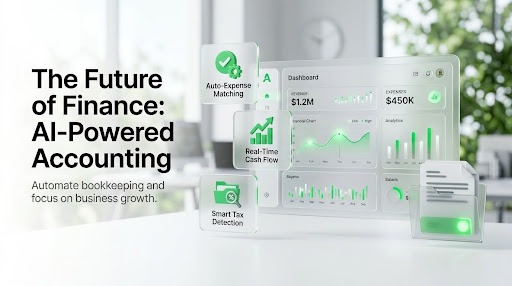
Artificial intelligence is transforming the accounting industry by automating repetitive financial tasks, improving accuracy, and helping businesses make faster, data-driven decisions. Traditional bookkeeping required accountants to manually enter transactions, reconcile accounts, categorize expenses, and generate financial reports. Today, AI accounting software performs many of these tasks automatically, allowing finance teams to focus on strategy, forecasting, and business growth instead of routine administration.
Modern AI-powered accounting platforms combine machine learning, intelligent automation, cloud computing, and predictive analytics to streamline financial management. These systems can automatically import bank transactions, classify expenses, detect duplicate entries, identify unusual spending patterns, generate invoices, predict cash flow, and provide real-time financial insights. Many also integrate seamlessly with payroll systems, payment gateways, customer relationship management (CRM) software, inventory management platforms, and e-commerce applications, creating a connected financial ecosystem.
As more businesses embrace digital transformation, selecting the right AI accounting software has become increasingly important. Some platforms focus on automation for freelancers and small businesses, while others deliver enterprise-grade artificial intelligence for multinational organizations. This guide explores the leading AI accounting software solutions in 2026, compares their strengths and capabilities, and explains how to choose the best platform for your business.
What Is AI Accounting Software?
AI accounting software is a financial management platform that uses artificial intelligence, machine learning, and automation technologies to simplify accounting tasks that traditionally required manual effort. Instead of relying solely on user input, AI-powered systems analyze financial data, recognize transaction patterns, categorize expenses automatically, detect anomalies, and provide intelligent recommendations that improve bookkeeping accuracy.
Unlike conventional accounting software, AI applications continuously learn from user behavior and historical financial information. Over time, they become more accurate when classifying expenses, matching invoices, reconciling bank transactions, and identifying potential errors. Many platforms also use predictive analytics to forecast cash flow, estimate future expenses, and generate financial insights that help business owners make proactive decisions.
Most AI accounting software is cloud-based, allowing secure access from any location while ensuring automatic software updates, encrypted data storage, and regular backups. By combining intelligent automation with real-time collaboration, these platforms reduce administrative workload, improve compliance, and enable finance teams to spend more time on strategic planning rather than repetitive bookkeeping.
Why Businesses Are Adopting AI Accounting Software
Businesses across every industry are adopting AI accounting software because it delivers greater efficiency, improved accuracy, and valuable financial insights. Manual bookkeeping is time-consuming and prone to human error, especially as transaction volumes increase. Artificial intelligence eliminates much of this repetitive work by automatically processing financial data, reducing duplicate entries, and accelerating routine accounting tasks.
Another significant advantage is access to real-time financial information. Traditional accounting often relies on month-end reporting, which delays decision-making. AI-powered accounting systems continuously analyze transactions and update dashboards, allowing managers to monitor cash flow, profitability, expenses, and outstanding invoices at any time. This immediate visibility helps businesses respond quickly to financial challenges and opportunities.
AI also improves collaboration between business owners, accountants, and finance teams. Because cloud-based platforms synchronize information instantly, multiple users can access the same financial records without version conflicts. Intelligent reporting, automated workflows, and predictive analytics further enhance decision-making by highlighting trends and identifying potential risks before they become costly problems.
Key Benefits
AI accounting software provides numerous advantages beyond simple automation. By reducing manual bookkeeping and improving data accuracy, businesses save time while strengthening financial management.
Some of the most valuable benefits include:
- Automatic expense categorization
- AI-powered bank reconciliation
- Intelligent invoice processing
- Predictive cash flow forecasting
- Automated financial reporting
- Fraud and anomaly detection
- Real-time dashboards
- Smart tax calculations
- Receipt scanning using AI
- Workflow automation
- Reduced bookkeeping errors
- Improved decision-making
These features enable businesses to operate more efficiently while providing finance teams with deeper insights into overall financial performance.
Potential Challenges
Although AI accounting software offers significant advantages, businesses should also consider several challenges before implementation. Data migration from existing accounting systems requires careful planning, particularly for organizations with extensive financial histories. Employees may also require training to understand new AI-assisted workflows and automation features.
Subscription costs vary depending on the software’s capabilities, number of users, and advanced AI features. Businesses should also evaluate integration compatibility with payroll, banking, inventory, and CRM systems before selecting a platform. Security and regulatory compliance remain equally important, making it essential to choose providers that offer strong encryption, role-based permissions, audit trails, and regular software updates.
Essential Features to Look For
Selecting the right AI accounting software begins with identifying the automation features that provide the greatest value for your business. Core capabilities should include automated bank feeds, AI-powered expense categorization, invoice management, financial reporting, bank reconciliation, and cash flow monitoring. These functions significantly reduce manual accounting while improving accuracy and efficiency.
More advanced platforms also offer predictive analytics, intelligent forecasting, anomaly detection, automated approval workflows, tax compliance tools, inventory management, payroll integration, and customizable dashboards. Businesses using multiple software systems should prioritize platforms with extensive third-party integrations to eliminate duplicate data entry and streamline business operations.
Scalability is another critical factor. As organizations grow, accounting requirements become increasingly complex. Choosing AI accounting software that supports additional users, larger transaction volumes, advanced reporting, and enterprise-level automation ensures the platform continues to meet business needs over the long term.
Best AI Accounting Software in 2026
QuickBooks Online
QuickBooks Online remains one of the most widely used AI-powered accounting platforms for small and medium-sized businesses. The software incorporates artificial intelligence into many everyday accounting processes, including automated expense categorization, intelligent bank reconciliation, receipt scanning, invoice reminders, and financial reporting. These capabilities reduce manual bookkeeping while improving overall accuracy.
One of QuickBooks Online’s greatest strengths is its extensive ecosystem of third-party integrations. Businesses can connect payroll systems, payment gateways, customer relationship management software, inventory platforms, and e-commerce applications with minimal effort. AI-powered transaction matching and bank feeds automatically import and organize financial data, helping accountants complete reconciliations much faster than manual methods.
The platform also provides customizable dashboards and real-time financial reports that enable business owners to monitor profitability, expenses, cash flow, and outstanding invoices from a single interface. Combined with strong customer support and widespread adoption among accounting professionals, QuickBooks Online continues to be one of the most trusted AI accounting solutions available.
Xero
Xero has become one of the leading cloud accounting platforms by combining automation, artificial intelligence, and collaboration within an intuitive user interface. Designed primarily for growing businesses, Xero automates many repetitive accounting tasks while allowing multiple users to collaborate simultaneously without additional complexity.
AI-enhanced features include smart bank reconciliation, automated invoice processing, expense management, recurring billing, and intelligent transaction matching. These capabilities reduce manual data entry while ensuring financial records remain accurate and up to date. Xero also provides customizable reporting and real-time dashboards that help businesses monitor financial performance and make informed decisions.
Another major advantage is Xero’s extensive integration marketplace. Businesses can connect payroll software, CRM platforms, payment gateways, inventory systems, and e-commerce tools to create a fully integrated financial management ecosystem. This flexibility makes Xero an excellent option for organizations seeking both automation and scalability.
Zoho Books
Zoho Books has become a strong contender in the AI accounting software market by combining intelligent automation with an affordable pricing structure. It is particularly popular among startups and small to medium-sized businesses that want to automate bookkeeping without investing in enterprise-level accounting systems. Businesses already using Zoho CRM, Zoho Inventory, or other Zoho applications benefit from seamless data synchronization across the entire Zoho ecosystem.
The platform uses AI-powered automation to simplify recurring invoices, expense categorization, payment reminders, bank reconciliation, and workflow approvals. By reducing repetitive manual work, finance teams can focus more on analyzing financial performance and supporting business growth. Zoho Books also provides customizable dashboards, automated financial reports, tax management tools, and customer portals that improve both operational efficiency and customer experience.
Another advantage is its user-friendly mobile application, which enables business owners to monitor cash flow, approve transactions, upload receipts, and create invoices from virtually anywhere. Combined with its automation capabilities and competitive pricing, Zoho Books remains one of the best AI-driven accounting solutions for growing businesses.
Sage Intacct
Sage Intacct is an enterprise-grade cloud accounting platform built for organizations requiring advanced financial management and AI-powered automation. Unlike entry-level accounting software, Sage Intacct is designed to automate complex accounting processes across multiple departments, business entities, and geographic regions while maintaining high levels of financial accuracy and regulatory compliance.
Artificial intelligence supports intelligent workflow automation throughout the platform. Businesses can automate accounts payable, accounts receivable, revenue recognition, approval processes, expense management, and financial consolidations. These automated workflows significantly reduce manual intervention while improving consistency and operational efficiency. Real-time dashboards provide executives with immediate access to financial performance metrics, allowing faster strategic decision-making.
Sage Intacct also excels in compliance and audit readiness. Detailed audit trails, role-based security, automated controls, and customizable financial reporting help organizations meet regulatory requirements while improving transparency. Businesses experiencing rapid growth or managing complex financial operations often choose Sage Intacct because of its scalability and enterprise-focused capabilities.
Oracle NetSuite
Oracle NetSuite is one of the most advanced AI-powered enterprise resource planning (ERP) platforms available today. It combines accounting, finance, inventory management, procurement, customer relationship management, and business analytics within a unified cloud platform. This integrated approach enables organizations to automate financial operations while maintaining complete visibility across every department.
Artificial intelligence enhances NetSuite through intelligent transaction matching, predictive analytics, financial forecasting, anomaly detection, automated revenue recognition, and cash flow analysis. The platform continuously analyzes business data to identify trends, highlight unusual transactions, and provide actionable insights that support informed decision-making. These capabilities help finance teams reduce manual work while improving forecasting accuracy.
NetSuite is particularly valuable for medium-sized and large organizations operating across multiple subsidiaries or international markets. Multi-currency accounting, consolidated financial reporting, tax compliance, and customizable dashboards make it a comprehensive solution for businesses with complex accounting requirements. Although implementation requires careful planning, the long-term productivity and automation benefits are substantial.
FreshBooks
FreshBooks focuses on freelancers, consultants, agencies, and service-based businesses that need intelligent automation for invoicing, expense management, and client billing. While it is not intended to compete directly with enterprise accounting platforms, it offers AI-assisted features that simplify daily bookkeeping and reduce administrative work.
Automation capabilities include recurring invoices, automatic payment reminders, smart expense categorization, receipt scanning, online payment collection, and time tracking. Businesses that bill clients based on hourly work particularly benefit from FreshBooks because tracked time can be converted directly into invoices without manual calculations. This improves billing accuracy while saving considerable administrative time.
FreshBooks also provides financial reports, project collaboration tools, and a clean user interface that requires minimal accounting knowledge. Its emphasis on simplicity makes it one of the easiest AI accounting platforms for independent professionals to adopt. Entrepreneurs looking for automation without unnecessary complexity often find FreshBooks to be an excellent solution.
AI Accounting Software Comparison Table
| Software | Best For | AI Features | Automation Level | Mobile App | Scalability |
|---|---|---|---|---|---|
| QuickBooks Online | Small Businesses | Smart categorization, receipt capture | Excellent | ✔ | High |
| Xero | Growing Businesses | Smart reconciliation, invoice automation | Excellent | ✔ | High |
| Zoho Books | SMBs | Workflow automation, AI categorization | Excellent | ✔ | High |
| Sage Intacct | Mid-sized & Enterprise | Financial automation, AI insights | Enterprise | ✔ | Excellent |
| Oracle NetSuite | Large Enterprises | Predictive analytics, anomaly detection | Enterprise | ✔ | Excellent |
| FreshBooks | Freelancers | Smart invoicing, expense automation | Good | ✔ | Moderate |
Pricing Considerations
When evaluating AI accounting software, businesses should consider the overall value rather than focusing only on subscription costs. AI-powered platforms often reduce manual bookkeeping, accelerate financial reporting, improve cash flow management, and minimize accounting errors. These productivity gains frequently offset higher subscription fees through significant time savings and improved operational efficiency.
Most providers offer multiple pricing tiers that increase in functionality as businesses grow. Entry-level plans typically include bookkeeping, invoicing, bank reconciliation, and basic automation. Higher-tier subscriptions unlock advanced AI features such as predictive analytics, approval workflows, inventory management, payroll integration, financial forecasting, and enterprise reporting.
Organizations should also consider implementation costs, employee training, integration requirements, customer support quality, and future scalability. Investing in software that can adapt to changing business requirements often delivers greater long-term value than choosing the least expensive option available.
How to Choose the Right AI Accounting Software
The ideal AI accounting platform depends on your business size, industry, and financial management needs. Freelancers generally prioritize invoicing, expense tracking, and time billing, while retailers often require inventory management and automated purchase orders. Larger organizations may need advanced forecasting, multi-entity consolidation, compliance reporting, and AI-powered financial analytics.
Ease of use should remain a top priority. Even the most advanced artificial intelligence provides limited value if employees struggle to navigate the software. Evaluate the platform’s interface, onboarding process, documentation, customer support, and training resources before making a decision. Integration with existing payroll systems, banking platforms, CRM software, and e-commerce tools should also be carefully reviewed to maximize automation benefits.
Finally, choose software that supports long-term growth. As transaction volumes increase and business operations become more complex, scalable AI accounting software will continue meeting organizational needs without requiring disruptive migrations to another platform.
Common Mistakes to Avoid When Choosing AI Accounting Software
Selecting AI accounting software without carefully evaluating your business requirements is one of the most common mistakes organizations make. Many businesses assume that every platform offering artificial intelligence delivers the same level of automation, but AI capabilities vary significantly between providers. Some applications focus primarily on automating bookkeeping tasks such as expense categorization and bank reconciliation, while others include advanced features like predictive cash flow forecasting, fraud detection, intelligent financial analysis, and automated compliance reporting. Before investing in any solution, identify which accounting processes consume the most time and choose software that directly addresses those challenges.
Another common mistake is overlooking software integration. Modern businesses rarely rely on a single application to manage operations. Customer relationship management (CRM) systems, payroll software, inventory management tools, e-commerce platforms, and payment gateways all generate financial data that should flow seamlessly into the accounting system. Choosing AI accounting software with limited integration capabilities often leads to duplicate data entry, inconsistent records, and unnecessary manual work. Verifying compatibility with your existing technology stack before implementation helps maximize automation and improve operational efficiency.
Businesses should also avoid underestimating the importance of employee training and data security. Artificial intelligence can automate many accounting tasks, but employees still need to understand how to review automated transactions, interpret AI-generated insights, and handle exceptions correctly. Comprehensive onboarding and ongoing training help ensure staff fully utilize the software’s capabilities. Security is equally critical because accounting systems contain highly sensitive financial information. Prioritize platforms that provide encryption, multi-factor authentication, role-based access controls, automatic backups, audit trails, and compliance with relevant financial regulations. Choosing secure, scalable software supported by reliable customer service will position your organization for long-term success.
Conclusion
AI accounting software has revolutionized financial management by combining artificial intelligence, cloud computing, and automation to simplify bookkeeping, improve reporting accuracy, and deliver valuable business insights. Tasks that once required hours of manual effort including expense categorization, invoice processing, bank reconciliation, financial reporting, and cash flow analysis can now be completed automatically with greater speed and consistency. As a result, finance professionals spend less time on repetitive administrative work and more time supporting strategic decision-making and business growth.
Each AI accounting platform serves different business needs. QuickBooks Online remains one of the strongest all-around solutions for small and medium-sized businesses thanks to its intelligent automation, extensive integrations, and user-friendly interface. Xero is an excellent option for growing companies that require collaboration, automation, and flexible scalability. Zoho Books offers outstanding workflow automation and exceptional value, particularly for businesses already using other Zoho products. FreshBooks is ideal for freelancers and service-based businesses seeking smart invoicing and simplified bookkeeping. Sage Intacct provides enterprise-level financial management with advanced compliance and reporting capabilities, while Oracle NetSuite delivers one of the most comprehensive AI-powered ERP and accounting solutions for large organizations with complex financial operations.
Choosing the right AI accounting software requires more than comparing pricing plans. Businesses should evaluate automation capabilities, AI features, reporting tools, integration options, scalability, security, ease of use, and customer support. Taking advantage of free trials, demonstrations, and pilot implementations allows organizations to assess how each platform performs within their actual workflows before making a long-term commitment. With the right AI accounting solution, businesses can increase productivity, reduce errors, improve financial visibility, and build a stronger foundation for sustainable growth in an increasingly digital economy.
Frequently Asked Questions
1. What is AI accounting software?
AI accounting software uses artificial intelligence, machine learning, and automation to perform accounting tasks such as expense categorization, bank reconciliation, invoice processing, financial reporting, and cash flow forecasting. It helps reduce manual work while improving bookkeeping accuracy and efficiency.
2. Is AI accounting software suitable for small businesses?
Yes. Many AI accounting platforms are specifically designed for small businesses and freelancers. Solutions like QuickBooks Online, Xero, Zoho Books, and FreshBooks provide intelligent automation that simplifies bookkeeping without requiring advanced accounting knowledge.
3. Can AI replace accountants?
No. AI is designed to assist accountants rather than replace them. While artificial intelligence can automate repetitive tasks and analyze financial data, accountants continue to play an essential role in financial planning, tax strategy, auditing, compliance, business consulting, and interpreting complex financial information.
4. How does AI improve bookkeeping accuracy?
AI improves accuracy by automatically categorizing transactions, detecting duplicate entries, identifying unusual spending patterns, matching bank transactions, scanning receipts, and reducing manual data entry. These capabilities minimize human errors while ensuring more consistent financial records.
5. How do I choose the best AI accounting software?
Start by identifying your business requirements, including invoicing, payroll, inventory management, reporting, integrations, compliance, and future growth plans. Compare AI capabilities, automation features, ease of use, security, scalability, customer support, and pricing before selecting the platform that best fits your organization.