
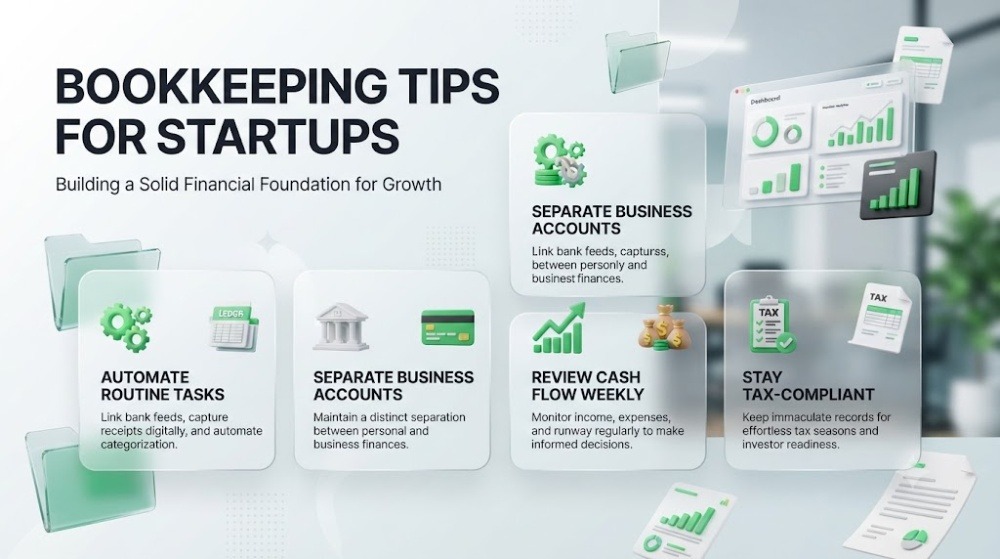
Bookkeeping Tips for Startups
For any early-stage startup, mastering the basics of bookkeeping is not just about staying compliant with tax laws—it is a critical driver of strategic growth. Many founders make the mistake of treating financial tracking as an afterthought, leading to messy spreadsheets, missed deductions, and a clouded view of their actual runway. By separating your personal and business accounts from day one and selecting a cloud-based accounting platform that scales with your operations, you build a solid foundation. This structural clarity ensures you can monitor cash flow in real-time, understand your true burn rate, and make confident, data-backed decisions instead of operating on guesswork.
To keep your financial engine running smoothly without letting it take over your workweek, the key lies in automation and consistent, bite-sized routines. Setting up digital receipt capture tools and linking your bank feeds directly to your ledger eliminates the pain of manual data entry and prevents crucial tax write-offs from slipping through the cracks. Instead of letting financial paperwork pile up into an overwhelming end-of-month chore, dedicating just fifteen minutes a week to categorize transactions and review outstanding invoices keeps your books immaculate. This proactive discipline not only prepares you for effortless tax seasons but also ensures you have investor-ready financial statements the moment a funding or growth opportunity arises.
Why Bookkeeping Matters for Every Startup
Starting a business is exciting. You’re building products, finding customers, pitching investors, and trying to grow as quickly as possible. Amid all that excitement, bookkeeping often feels like a boring administrative task that can wait until later. Unfortunately, that mindset is one of the biggest reasons many startups struggle financially. Accurate bookkeeping isn’t just about satisfying tax authorities—it provides a clear picture of your company’s financial health and helps you make informed business decisions every day.
Recent industry guidance from accounting experts continues to emphasize that startups with organized bookkeeping are better prepared for funding rounds, tax compliance, and sustainable growth. Financial professionals consistently recommend implementing bookkeeping systems from day one instead of trying to reconstruct months of transactions later.
Another compelling statistic frequently cited in startup finance discussions is that cash flow problems contribute to the majority of startup failures, making consistent financial tracking an essential survival tool rather than an optional administrative process.
Instead of viewing bookkeeping as a chore, successful founders treat it like the dashboard of a car. Imagine driving hundreds of miles without looking at your speedometer or fuel gauge. Eventually, you’ll run into trouble. Your bookkeeping system works the same way by telling you how much money is coming in, where it’s going, and whether your business is moving toward profitability.
The Difference Between Bookkeeping and Accounting
Many new entrepreneurs use the terms bookkeeping and accounting interchangeably, but they are not exactly the same thing. Understanding the distinction helps you know which tasks you can handle yourself and when professional expertise becomes valuable.
Bookkeeping is the daily process of recording financial transactions. Every sale, invoice, payment, refund, payroll expense, and subscription should be documented accurately. Think of bookkeeping as collecting all the puzzle pieces that represent your business activity. Without those pieces, no one can understand the complete financial picture.
Accounting takes those organized records and transforms them into meaningful insights. Accountants prepare financial statements, forecast future performance, calculate taxes, identify trends, and advise on strategic decisions. Simply put, bookkeeping records the story, while accounting explains what the story means for your business. This distinction is widely recognized by finance professionals and startup advisors.
For an early-stage startup, founders often manage bookkeeping themselves using cloud-based software. As revenue increases, transactions multiply, employees join the company, and investors request detailed reports, professional accounting support becomes increasingly valuable.
Why Investors Care About Clean Books
If your startup plans to raise outside funding, your bookkeeping practices will receive far more attention than many founders expect. Venture capital firms, angel investors, and lenders all perform financial due diligence before committing money. Poor bookkeeping creates uncertainty, and uncertainty increases investment risk.
Imagine presenting impressive revenue growth to an investor while being unable to explain where your expenses came from. Missing invoices, uncategorized transactions, or inconsistent financial reports immediately raise concerns about management quality. Investors don’t simply evaluate your product—they evaluate your ability to manage a growing business responsibly.
Clean financial records also make it easier to calculate important startup metrics such as monthly recurring revenue (MRR), gross margin, customer acquisition cost (CAC), burn rate, runway, and net profit. These metrics influence investment decisions because they reveal how efficiently the business operates.
Professional bookkeeping also speeds up due diligence dramatically. Instead of spending weeks organizing documents before investor meetings, you’ll already have accurate profit and loss statements, balance sheets, cash flow reports, payroll records, and tax documentation ready for review. This level of preparedness demonstrates professionalism and builds investor confidence before negotiations even begin.
Setting Up Your Startup’s Financial Foundation
Building an effective bookkeeping system starts long before your first tax filing. It begins the day your business starts accepting or spending money. Establishing good habits early saves countless hours later and prevents expensive mistakes that become difficult to untangle.
The very first step is creating a dedicated financial structure for your company. This means opening separate business bank accounts, obtaining a business credit card, selecting accounting software, and deciding whether you’ll use cash accounting or accrual accounting. Financial experts consistently rank separating personal and business finances as one of the most important bookkeeping practices for startups.
Once your financial foundation is in place, every transaction should flow through your bookkeeping system rather than relying on memory or scattered receipts. Cloud accounting platforms now automate many repetitive tasks by importing bank transactions, matching receipts, categorizing expenses using artificial intelligence, and generating financial reports in real time. Automation reduces errors while giving founders more time to focus on growth.
Open Separate Business Bank Accounts
One of the fastest ways to create bookkeeping headaches is mixing personal and business finances. Although many founders initially use personal accounts for convenience, doing so quickly becomes confusing as transaction volume increases. Every coffee purchased for a client, software subscription, or equipment expense becomes harder to distinguish from personal spending.
A dedicated business bank account creates a clean financial trail. It simplifies tax preparation, improves financial reporting, strengthens legal separation between personal and business assets, and enhances credibility with customers and investors alike. Most bookkeeping professionals consider this a non-negotiable first step for every startup.
Using a business credit card provides additional advantages because expenses are automatically consolidated into monthly statements, making reconciliation much easier. It also helps establish business credit, which may become valuable when seeking financing for future expansion.
Choosing the Right Accounting Method
Before your startup begins processing a high volume of transactions, it’s important to choose an accounting method that fits your business model. The two primary options are cash accounting and accrual accounting. While both help you track your finances, they record income and expenses differently, which affects how your financial reports look.
Under the cash accounting method, income is recorded when money is actually received, and expenses are recorded when they are paid. This approach is straightforward and works well for many small businesses and early-stage startups with simple operations. It provides a clear picture of the cash currently available in your bank account, making it easier to manage daily spending.
The accrual accounting method records income when it is earned and expenses when they are incurred, regardless of when money changes hands. Although it requires more detailed bookkeeping, accrual accounting offers a more accurate view of your company’s financial performance over time. Many investors and lenders prefer accrual-based financial statements because they better reflect the true health of a growing business.
When selecting a method, consider your startup’s size, revenue model, and future growth plans. If you expect to seek investment, manage inventory, or scale rapidly, implementing accrual accounting early can save time and reduce the need for major changes later. Whichever method you choose, consistency is essential. Switching back and forth between methods without professional guidance can create confusion and make financial reporting unreliable
Essential Bookkeeping Tips Every Startup Should Follow
Strong bookkeeping habits don’t require a finance degree. They require consistency, organization, and the willingness to review your numbers regularly. The following tips can help startups build a financial system that supports long-term success rather than simply meeting tax deadlines.
Track Every Transaction
Every dollar entering or leaving your business tells part of your financial story. Whether it’s a customer payment, software subscription, travel expense, or office supply purchase, each transaction should be recorded promptly. Waiting until the end of the month or worse, the end of the year to organize financial records often results in forgotten expenses, duplicate entries, and unnecessary stress.
Using accounting software that automatically imports bank and credit card transactions can significantly reduce manual work. Even with automation, it’s important to review imported transactions to ensure they’re categorized correctly. Small errors repeated over hundreds of transactions can distort your financial reports and lead to poor business decisions.
Consistent transaction tracking also helps identify spending patterns. You may discover recurring subscriptions you no longer use, departments with rising costs, or customers who consistently pay invoices late. These insights are only possible when your bookkeeping records are complete and up to date.
Automate Routine Financial Tasks
Automation has transformed bookkeeping for startups. Instead of manually entering every transaction into a spreadsheet, modern accounting platforms can connect directly to your bank accounts, payment processors, payroll systems, and invoicing tools. This not only saves time but also reduces the risk of human error.
Consider automating tasks such as:
- Importing bank transactions
- Sending recurring invoices
- Payment reminders
- Receipt scanning
- Expense categorization
- Payroll processing
- Monthly financial reports
Automation doesn’t eliminate the need for oversight. Instead, it allows founders to focus on reviewing financial information rather than entering data. Think of automation as a reliable assistantit handles repetitive tasks while you make the important decisions.
Categorize Expenses Correctly
Accurate expense categorization is one of the foundations of reliable bookkeeping. Every business expense should be assigned to the appropriate category, such as marketing, payroll, software, office supplies, utilities, travel, or professional services. Proper categorization makes it easier to understand where your money is going and simplifies tax preparation.
For example, if marketing expenses suddenly increase over several months, correctly categorized records make that trend immediately visible. You can then evaluate whether those additional costs are generating enough new customers to justify the investment.
Misclassified expenses create confusion during tax season and can result in inaccurate financial statements. Establish clear expense categories early and use them consistently. As your startup grows, you can expand your chart of accounts to reflect new business activities while maintaining organized records.
Reconcile Your Bank Accounts Every Month
Bank reconciliation involves comparing your bookkeeping records with your bank statements to ensure they match. Although it may seem like a tedious task, monthly reconciliation helps identify missing transactions, duplicate entries, bank errors, unauthorized charges, and accounting mistakes before they become larger problems.
Waiting several months to reconcile accounts makes discrepancies much harder to investigate. A forgotten payment from six months ago can take hours to trace, while a transaction from last week is usually easy to verify.
Monthly reconciliation also improves confidence in your financial reports. When your records match your bank statements, you can make budgeting, hiring, and investment decisions knowing your financial data is accurate.
Monitor Cash Flow Every Week
Profit and cash flow are not the same thing. A startup may appear profitable on paper while struggling to pay suppliers because customer payments haven’t arrived yet. This is why successful founders review cash flow regularly instead of relying solely on profit figures.
Monitoring cash flow helps answer questions such as:
| Question | Why It Matters |
|---|---|
| How much cash is available today? | Determines immediate spending capacity. |
| Which invoices remain unpaid? | Helps improve collections. |
| What expenses are due next month? | Supports budgeting and planning. |
| How many months of runway remain? | Essential for startups seeking growth or investment. |
Reviewing these figures weekly allows founders to anticipate financial challenges before they become emergencies. Strong cash flow management gives startups the flexibility to invest confidently while avoiding unnecessary debt.
Save Every Receipt Digitally
One of the easiest bookkeeping habits to overlook is keeping receipts. Yet those small pieces of paper—or digital invoices—can become invaluable during tax season, financial audits, or when verifying business expenses. Instead of stuffing paper receipts into a drawer, create a digital system from the beginning.
Modern bookkeeping apps allow you to scan receipts using your smartphone. The software extracts key information such as the vendor, date, amount, and tax, then attaches the receipt directly to the corresponding transaction. This eliminates manual filing while making documents searchable within seconds.
Digital recordkeeping also protects your business from lost or damaged paperwork. Paper receipts fade over time, while securely stored digital copies remain accessible whenever needed. Create folders organized by month or expense category and back them up using cloud storage to ensure you never lose critical financial records.
Developing the habit of uploading receipts immediately after every purchase takes only a few seconds but can save hours of searching later. Consistency is far more valuable than trying to organize months of paperwork all at once.
Choosing Bookkeeping Software
The right bookkeeping software can dramatically improve efficiency, accuracy, and financial visibility. Rather than spending hours entering transactions into spreadsheets, cloud-based platforms automate many repetitive tasks while generating reports in real time.
When evaluating software, prioritize features that align with your startup’s needs rather than simply choosing the cheapest option. A growing business benefits from software that can scale alongside increased transaction volumes and additional users.
Features to Look For
Look for bookkeeping software that includes:
- Automatic bank feeds
- Invoice creation and payment tracking
- Expense categorization
- Receipt scanning
- Payroll integration
- Tax reporting
- Financial dashboards
- Cash flow reporting
- Multi-user access
- Mobile applications
These features reduce administrative work while providing a clearer understanding of your startup’s financial performance.
Comparison of Popular Bookkeeping Software
| Software | Best For | Key Features | Free Plan |
|---|---|---|---|
| QuickBooks Online | Small businesses and startups | Invoicing, payroll, reporting, bank feeds | No |
| Xero | Growing startups | Unlimited users, inventory, bank reconciliation | No |
| Wave | Freelancers and very small businesses | Basic bookkeeping and invoicing | Yes |
| Zoho Books | Small businesses | Automation, GST/VAT support, workflow management | Limited |
| FreshBooks | Service-based startups | Time tracking, invoicing, expense management | No |
No single solution is perfect for every startup. Consider your budget, expected growth, industry, and integration requirements before making a decision.
When Should You Hire a Professional Bookkeeper?
Many founders begin by managing their own books. This approach works during the earliest stages when transaction volume is relatively low. However, as the business grows, bookkeeping becomes more time-consuming and increasingly complex.
Consider hiring a professional bookkeeper if:
- Transactions have become difficult to manage.
- Payroll is consuming significant time.
- You’re preparing for fundraising.
- Tax compliance is becoming complicated.
- Financial reports contain frequent errors.
- You’re spending more time on bookkeeping than growing your business.
A professional bookkeeper doesn’t simply organize numbers—they help ensure financial accuracy, reduce compliance risks, and provide reports that support better decision-making.
Common Startup Bookkeeping Mistakes
Even successful entrepreneurs make bookkeeping mistakes. The key is identifying them early before they become expensive problems.
Mixing Personal and Business Finances
Using one account for both personal and business spending creates unnecessary confusion. Separate accounts simplify bookkeeping, improve tax reporting, and strengthen your business’s professional image.
Waiting Until Tax Season
Trying to organize an entire year’s financial records just before filing taxes often results in missing expenses, inaccurate reports, and unnecessary stress. Weekly or monthly bookkeeping sessions are far more manageable.
Ignoring Financial Reports
Financial statements are valuable decision-making tools, not documents to review only when required. Regularly examine your:
- Profit and Loss Statement
- Balance Sheet
- Cash Flow Statement
These reports reveal trends, identify financial risks, and help guide strategic planning.
Failing to Budget
A realistic budget provides direction for spending and growth. Without one, startups often overspend in some areas while underinvesting in others.
Not Backing Up Financial Data
Cloud accounting platforms are reliable, but maintaining secure backups of important financial documents adds another layer of protection against unexpected data loss.
Organize Receipts and Invoices
Receipts are your proof that business expenses actually occurred. Instead of keeping paper receipts in a drawer or shoebox, digitize them immediately using mobile scanning apps or accounting software.
Invoices should also be stored systematically. Organize both incoming supplier invoices and outgoing customer invoices by date and customer or vendor. A consistent filing system reduces confusion and ensures supporting documents are available whenever needed.
Weekly and Monthly Bookkeeping Tasks
Reconcile Bank Accounts
Bank reconciliation compares your bookkeeping records with your bank statement to ensure everything matches correctly. This process identifies duplicate entries, missing transactions, unauthorized charges, and bank errors before they become larger problems.
Many experienced bookkeepers recommend reconciling accounts monthly at a minimum, while businesses with high transaction volumes often reconcile weekly. Consistent reconciliation improves financial accuracy and keeps your reports trustworthy.
Review Cash Flow
Profit doesn’t always equal available cash. A profitable company can still experience cash shortages if customers delay payments or expenses increase unexpectedly. Reviewing cash flow regularly helps identify future funding gaps before they become emergencies.
A simple monthly cash flow review should include money received, bills due, expected customer payments, payroll obligations, and upcoming tax payments. Understanding cash movement allows business owners to plan confidently rather than reacting to surprises.
Follow Up on Outstanding Invoices
Late customer payments can disrupt business operations even when sales remain strong. Every week, review unpaid invoices and politely remind customers about approaching or overdue payment deadlines.
Many accounting platforms automate reminder emails, reducing administrative work while improving collection rates. Faster payments strengthen cash flow and reduce the need for external financing.
Common Types of Journal Entries
Not every journal entry records a daily sale or purchase. Businesses also use several specialized entries to ensure financial statements comply with accounting principles.
Adjusting entries recognize accrued expenses, prepaid expenses, depreciation, and earned but unrecorded revenue at the end of an accounting period. These entries ensure revenues and expenses are recognized in the correct reporting period.
Closing entries transfer temporary account balances, such as revenues and expenses, into retained earnings at year-end. This process resets income statement accounts for the next accounting period.
Reversing entries simplify bookkeeping in the following period by automatically reversing selected adjusting entries. Businesses often use these for accrued payroll or accrued expenses to avoid duplicate recording.
Each of these entries eventually flows into the general ledger, reinforcing why journal entries and ledgers cannot function independently.
Quarterly and Annual Bookkeeping Checklist
Prepare Financial Statements
Three financial reports deserve regular attention:
| Report | Purpose |
|---|---|
| Profit & Loss Statement | Measures profitability |
| Balance Sheet | Shows assets, liabilities, and equity |
| Cash Flow Statement | Tracks money moving in and out |
These reports provide valuable insight into business performance. Reviewing them quarterly helps identify trends before problems become serious.
Estimate and Pay Taxes
Taxes become much less stressful when bookkeeping remains current throughout the year. Quarterly tax estimates help avoid large unexpected payments and potential penalties.
Businesses operating under digital tax initiatives in several countries are increasingly encouraged or required to maintain electronic bookkeeping records. Recent research indicates businesses adopting digital bookkeeping report greater organization and reduced administrative stress.
Review Business Performance
Year-end bookkeeping should involve more than closing the books. Review revenue growth, profit margins, operating expenses, customer acquisition costs, and overall financial health.
Ask important questions:
- Which products generate the highest profit?
- Which expenses increased the most?
- Are pricing strategies still effective?
- Is cash flow improving?
- What financial goals should be set for next year?
This review transforms bookkeeping from a compliance task into a strategic business tool.
Common Bookkeeping Mistakes to Avoid
Mixing Personal and Business Finances
Using one bank account for everything remains one of the most common mistakes made by small business owners. It complicates reconciliation, increases accounting errors, and creates unnecessary tax headaches. Maintaining separate accounts should become a permanent habit from day one.
Ignoring Small Transactions
Many owners overlook inexpensive purchases because they seem insignificant individually. Yet dozens of small expenses each month can total thousands of dollars annually. Recording every transaction regardless of amount creates complete financial records and more accurate reports.
Conclusion
Strong bookkeeping isn’t just about staying organized it creates the financial foundation every successful startup needs. From separating personal and business finances to tracking every transaction and reviewing cash flow regularly, each habit contributes to better financial visibility and smarter decision-making. When founders understand exactly where their money comes from and where it goes, they can identify growth opportunities, reduce unnecessary expenses, and prepare confidently for future challenges.
Technology has made bookkeeping more accessible than ever. Cloud-based accounting software, automated bank feeds, digital receipt management, and real-time reporting allow startups to spend less time on manual data entry and more time building their business. Automation should complement, not replace, regular financial reviews. Founders who dedicate time each week to reviewing reports are far more likely to catch problems early and make informed strategic decisions.
As your startup grows, your bookkeeping processes should evolve alongside it. What works for a solo entrepreneur may not be sufficient once employees, investors, inventory, or international customers enter the picture. Periodically reviewing your financial systems ensures they continue to meet your business needs. Hiring a professional bookkeeper or accountant at the right stage can also free up valuable time while improving financial accuracy and compliance.
Ultimately, bookkeeping is more than a legal requirement it’s a competitive advantage. Clean, accurate financial records help you secure funding, simplify tax preparation, improve cash flow management, and build credibility with investors, lenders, and business partners. By treating bookkeeping as an ongoing business function rather than a once-a-year task, you’ll be better positioned to navigate uncertainty and build a startup that thrives for years to come.
Frequently Asked Questions (FAQs)
1. What bookkeeping tasks should a startup perform every week?
A startup should review bank transactions, record income and expenses, reconcile accounts if needed, monitor cash flow, follow up on unpaid invoices, and upload digital copies of receipts. Performing these tasks weekly prevents records from piling up and keeps financial information accurate.
2. Is bookkeeping software necessary for a new startup?
While it’s possible to manage bookkeeping using spreadsheets, dedicated bookkeeping software offers significant advantages. It automates repetitive tasks, reduces errors, generates financial reports, simplifies tax preparation, and scales as your business grows. Even small startups often save time by using cloud-based accounting software.
3. How often should bank accounts be reconciled?
Most financial professionals recommend reconciling business bank accounts at least once a month. Startups with a high volume of transactions may benefit from weekly reconciliations to identify discrepancies, detect fraud, and ensure financial reports remain accurate.
4. When should a startup hire a bookkeeper?
A startup should consider hiring a professional bookkeeper when financial records become difficult to manage, transaction volume increases significantly, payroll becomes more complex, or the company is preparing for funding, audits, or rapid expansion. Outsourcing bookkeeping allows founders to focus on growth while maintaining accurate financial records.
5. What are the biggest bookkeeping mistakes startups make?
Some of the most common mistakes include mixing personal and business finances, failing to track expenses consistently, delaying bookkeeping until tax season, ignoring financial reports, neglecting cash flow management, and not keeping digital copies of receipts. Establishing organized bookkeeping processes early helps avoid these costly errors.