
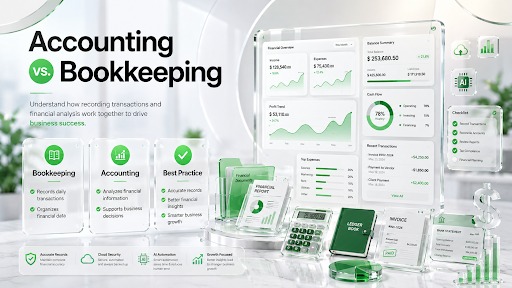
Difference Between Accounting and Bookkeeping
The difference between accounting and bookkeeping is one of the first concepts every business owner, student, freelancer, and entrepreneur should understand before managing business finances. Although many people use these two terms interchangeably, they perform different functions within a company’s financial management system. Bookkeeping focuses on recording daily financial transactions accurately, while accounting involves analyzing, interpreting, summarizing, and reporting the financial information collected through bookkeeping. Understanding the difference between accounting and bookkeeping helps businesses maintain accurate financial records, comply with tax regulations, improve decision-making, and monitor financial performance more effectively. Whether you are starting a small business or pursuing a career in finance, learning how bookkeeping and accounting work together will give you a strong financial foundation and help you make informed business decisions.
Understanding the Difference Between Accounting and Bookkeeping
Understanding the difference between accounting and bookkeeping begins with recognizing that both functions play essential roles in managing a company’s finances, yet they serve different purposes. Bookkeeping is primarily concerned with recording financial transactions accurately and consistently. Every sale, purchase, payment, receipt, payroll transaction, and expense is entered into the company’s financial records by a bookkeeper. These records create an organized financial database that reflects the daily activities of the business. Accuracy is extremely important because even small recording mistakes can affect financial reports, tax calculations, and business decisions later. Bookkeepers follow established procedures to ensure that financial information remains complete, organized, and easy to retrieve whenever needed.
What Is Bookkeeping?
Bookkeeping is the systematic process of recording, organizing, and maintaining every financial transaction that occurs within a business. It represents the first stage of the accounting cycle and provides the accurate financial data required for accounting functions. Every invoice issued, receipt collected, payment received, supplier bill, payroll transaction, and bank deposit must be recorded correctly to ensure the company’s financial records remain complete. Because bookkeeping focuses on day-to-day financial activities, consistency and attention to detail are essential skills for every bookkeeper.
What Is Accounting?
Accounting is the process of analyzing, interpreting, summarizing, and reporting financial information collected through bookkeeping. Rather than focusing on recording individual transactions, accountants examine financial data to evaluate business performance, prepare financial statements, ensure regulatory compliance, calculate taxes, and provide strategic financial advice. Accounting transforms thousands of recorded transactions into meaningful reports that help business owners, investors, lenders, and government agencies understand the financial health of an organization.Skills Required for Bookkeeping
Successful bookkeepers possess strong attention to detail, organizational abilities, mathematical accuracy, and proficiency with accounting software. They must be comfortable handling repetitive financial tasks while maintaining high levels of precision. Communication skills are also valuable because bookkeepers often coordinate with business owners, accountants, vendors, and financial institutions to resolve discrepancies and ensure records remain up to date.
Difference Between Accounting and Bookkeeping in Daily Business Operations
The difference between accounting and bookkeeping becomes much clearer when you look at how both functions operate in a typical business day. Every business, regardless of its size or industry, generates financial transactions continuously. Customers make purchases, suppliers send invoices, employees receive salaries, taxes become due, and business owners invest money back into operations. Bookkeepers are responsible for recording these transactions accurately and ensuring that every financial event is supported by proper documentation. Their work creates a reliable financial database that reflects the company’s daily activities. Without this organized system, businesses would struggle to monitor cash flow, prepare tax returns, or produce accurate financial reports.
Primary Responsibilities of a Bookkeeper
A bookkeeper is responsible for maintaining accurate and organized financial records on a daily basis. Their primary objective is to ensure that every financial transaction is recorded correctly, categorized appropriately, and supported by relevant documentation. Because bookkeeping forms the foundation of accounting, attention to detail is essential. Even a minor recording error can affect financial statements, tax calculations, and management reports later in the accounting process. This is one of the key reasons why understanding the difference between accounting and bookkeeping is so important for business owners.
The daily responsibilities of a bookkeeper typically include:
| Bookkeeper Responsibility | Purpose |
|---|---|
| Recording sales transactions | Maintain accurate revenue records |
| Recording business expenses | Track operating costs |
| Managing accounts payable | Ensure suppliers are paid on time |
| Managing accounts receivable | Monitor customer payments |
| Reconciling bank statements | Verify transaction accuracy |
| Processing payroll data | Record employee compensation |
| Maintaining general ledger | Organize financial information |
| Filing financial documents | Keep records organized for future reference |
These responsibilities require consistency, accuracy, and strong organizational skills rather than advanced financial analysis. Modern bookkeeping software automates many repetitive tasks, but human oversight remains necessary to verify transaction accuracy and resolve discrepancies. Businesses that maintain reliable bookkeeping records save time during audits, simplify tax preparation, and create a strong financial foundation for accounting activities.
Primary Responsibilities of an Accountant
While bookkeepers focus on recording transactions, accountants are responsible for interpreting and analyzing financial information. This distinction represents the core difference between accounting and bookkeeping. Accountants convert financial records into reports that explain business performance and support strategic decision-making. Their work requires analytical thinking, financial knowledge, and a thorough understanding of accounting principles, taxation, and financial reporting standards.
The primary responsibilities of an accountant include:
| Accountant Responsibility | Purpose |
|---|---|
| Preparing financial statements | Present business performance |
| Financial analysis | Evaluate profitability and efficiency |
| Budget preparation | Plan future business spending |
| Tax planning and compliance | Ensure accurate tax reporting |
| Financial forecasting | Predict future financial performance |
| Internal auditing | Verify financial accuracy |
| Business advisory services | Support management decisions |
| Regulatory compliance | Meet legal reporting requirements |
Unlike bookkeeping, accounting often involves professional judgment. Accountants evaluate trends, interpret financial ratios, recommend cost-saving strategies, and identify opportunities for business growth. They also communicate financial information to investors, lenders, government agencies, and business owners in a way that supports informed decision-making. By combining accurate bookkeeping records with detailed financial analysis, accountants help organizations improve profitability, reduce financial risks, and achieve long-term success.
Key Difference Between Accounting and Bookkeeping at a Glance
| Feature | Bookkeeping | Accounting |
|---|---|---|
| Primary Purpose | Record financial transactions | Analyze and interpret financial data |
| Main Focus | Daily financial records | Financial reporting and analysis |
| Skill Level | Organizational and data entry skills | Analytical and financial expertise |
| Financial Statements | Does not prepare complete statements | Prepares and interprets statements |
| Tax Planning | Maintains supporting records | Calculates and plans taxes |
| Decision Making | Limited involvement | Supports strategic decisions |
| Business Role | Operational | Strategic |
| Typical Users | Bookkeepers | Accountants, CPAs, Financial Managers |
This comparison summarizes the difference between accounting and bookkeeping in a simple format. While their responsibilities differ, both functions are essential for maintaining accurate financial information and supporting the long-term success of any business. Bookkeeping ensures that financial records are complete and reliable, whereas accounting uses those records to evaluate performance, ensure compliance, and provide guidance for future growth.
Difference Between Accounting and Bookkeeping Skills
Understanding the difference between accounting and bookkeeping also requires looking at the skills needed for each profession. Although both careers involve working with financial information, the knowledge, responsibilities, and expertise required are not the same. Bookkeepers concentrate on maintaining accurate financial records and ensuring that transactions are entered correctly. Their work requires precision, consistency, and strong organizational abilities. Accountants, however, go a step further by interpreting financial data, preparing reports, evaluating business performance, and advising organizations on financial strategies. Because accounting involves analysis and decision-making, accountants generally require more advanced education and technical knowledge than bookkeepers.
Skills Required for Bookkeeping
Bookkeeping focuses on accuracy, organization, and consistency. A bookkeeper records hundreds or even thousands of financial transactions, making attention to detail one of the most valuable skills in the profession. Missing a receipt, entering an incorrect amount, or assigning a transaction to the wrong account can create problems throughout the accounting process. Successful bookkeepers develop systematic workflows that help them maintain complete and accurate financial records while meeting deadlines consistently.
Essential bookkeeping skills include:
| Bookkeeping Skill | Why It Is Important |
|---|---|
| Attention to detail | Prevents recording errors |
| Organization | Keeps financial documents structured |
| Data entry accuracy | Ensures reliable financial records |
| Time management | Handles daily transaction volume efficiently |
| Basic accounting knowledge | Understands debit and credit principles |
| Communication | Coordinates with business owners and accountants |
| Computer literacy | Uses accounting software effectively |
| Confidentiality | Protects sensitive financial information |
These skills help bookkeepers establish a reliable financial foundation for the business. Their work ensures that accountants receive accurate financial data for analysis, reporting, and tax preparation. While bookkeeping may appear routine, it requires discipline, consistency, and a commitment to maintaining high-quality financial records.
Skills Required for Accounting
Accounting requires many of the same organizational skills used in bookkeeping, but it also demands advanced analytical abilities and a deeper understanding of financial management. Accountants examine financial information to identify trends, evaluate profitability, prepare budgets, calculate taxes, and advise management on strategic decisions. They must understand accounting standards, financial regulations, taxation rules, and reporting requirements while communicating complex financial information in a way that business owners can understand.
Key accounting skills include:
| Accounting Skill | Why It Is Important |
|---|---|
| Financial analysis | Evaluates business performance |
| Critical thinking | Solves financial problems |
| Tax knowledge | Ensures compliance with tax laws |
| Budget planning | Supports future financial decisions |
| Financial reporting | Prepares accurate statements |
| Analytical reasoning | Identifies financial trends |
| Problem-solving | Addresses accounting challenges |
| Decision-making | Advises business management |
These skills distinguish accountants from bookkeepers and highlight another important difference between accounting and bookkeeping. While bookkeeping records the numbers, accounting explains what those numbers mean and how they should influence future business decisions.
Difference Between Accounting and Bookkeeping: Side-by-Side Comparison
| Category | Bookkeeping | Accounting |
|---|---|---|
| Main Objective | Record transactions | Analyze financial information |
| Daily Work | Recording and organizing data | Reporting and interpreting data |
| Primary Output | General ledger | Financial statements |
| Level of Analysis | Basic | Advanced |
| Decision Support | Minimal | Significant |
| Tax Responsibilities | Maintain records | Prepare tax returns and planning |
| Education | Certificate or diploma often sufficient | Degree and professional qualifications often required |
| Business Impact | Operational efficiency | Strategic business growth |
This comparison reinforces the difference between accounting and bookkeeping by showing that bookkeeping is primarily operational, while accounting is analytical and strategic. Both professions complement each other and are essential for maintaining accurate financial information, supporting compliance, and helping businesses achieve long-term success.
Salary Expectations
Salary expectations vary depending on education, certifications, experience, industry, and geographic location. In general, accountants earn higher salaries because their work involves greater analytical responsibility, regulatory compliance, financial planning, and decision-making. Bookkeepers typically focus on transaction recording and financial organization, making the role an excellent starting point for individuals entering the finance profession.
Professionals who obtain certifications such as Certified Public Accountant (CPA), Chartered Accountant (CA), Certified Management Accountant (CMA), or Association of Chartered Certified Accountants (ACCA) often qualify for more advanced accounting positions and increased earning potential. Likewise, experienced bookkeepers who become proficient in cloud accounting software, payroll systems, and financial reporting can also significantly improve their career prospects. Whether you choose bookkeeping or accounting, continuous learning and technological skills will remain valuable as the finance industry continues to evolve.
Which One Does Your Business Need?
Many business owners wonder whether they should hire a bookkeeper, an accountant, or both. The answer depends on the size, complexity, and stage of the business. A freelancer or very small business with only a few monthly transactions may only require bookkeeping services to keep financial records organized. As the business grows, financial reporting becomes more complex, tax obligations increase, and strategic planning becomes more important. At that stage, professional accounting services become increasingly valuable.
Understanding the difference between accounting and bookkeeping helps business owners invest in the right financial support at the right time. Bookkeepers ensure that financial data remains accurate and up to date, while accountants transform that information into meaningful reports and recommendations. Together, they improve financial transparency, strengthen compliance, support business growth, and provide owners with confidence when making important financial decisions. Rather than viewing bookkeeping and accounting as competing services, businesses should recognize them as complementary functions that work together to build a strong financial foundation.
Conclusion
Understanding the difference between accounting and bookkeeping is essential for anyone who wants to manage finances effectively, build a successful business, or pursue a career in finance. Although the two terms are often used interchangeably, they perform distinct yet closely connected roles. Bookkeeping focuses on accurately recording daily financial transactions, maintaining organized financial records, and ensuring that every business activity is properly documented. Accounting builds on that foundation by analyzing financial information, preparing reports, ensuring regulatory compliance, developing budgets, planning taxes, and providing valuable insights that guide business decisions.
Neither function is more important than the other because both contribute to a healthy financial management system. Without accurate bookkeeping, accountants cannot produce reliable financial statements or meaningful financial analysis. Likewise, without accounting, businesses would struggle to understand their financial performance, identify growth opportunities, or make informed strategic decisions. Modern accounting software has made both professions more efficient, but human expertise remains essential for maintaining accuracy and interpreting financial information.
Frequently Asked Questions (FAQs)
1. What is the main difference between accounting and bookkeeping?
The primary difference between accounting and bookkeeping is that bookkeeping records daily financial transactions, while accounting analyzes, summarizes, and interprets those records to prepare financial reports and support business decisions.
2. Can a small business operate with only bookkeeping?
Yes, many small businesses begin with only bookkeeping to maintain accurate financial records. As the business grows, accounting services become increasingly important for tax planning, financial reporting, budgeting, and strategic decision-making.
3. Is bookkeeping easier than accounting?
Bookkeeping is generally considered more straightforward because it focuses on recording financial transactions accurately. Accounting requires additional analytical skills, financial reporting knowledge, tax expertise, and an understanding of accounting standards.
4. Which software is suitable for both bookkeeping and accounting?
Several cloud-based platforms support both bookkeeping and accounting functions, including QuickBooks, Xero, Zoho Books, Sage 50, and FreshBooks. The best choice depends on the size and specific needs of the business.
5. Can a bookkeeper become an accountant?
Yes. Many accountants begin their careers as bookkeepers. By gaining experience, completing higher education, and earning professional certifications such as CPA, CA, ACCA, or CMA, a bookkeeper can transition into an accounting career with greater responsibilities and career opportunities.